

“How old is he? I typed in the Facebook chat, “Cause if he’s under 11, there is a financial grant available to help with speech therapy.”
The reply came back quickly, “There are GRANTS?!?!?! Why does no one tell people this? We put off therapy because we thought we couldn’t afford it!”
“I really want to have them tested, but the school said they can’t do anything until they are in Grade One, and when I googled private evaluations, everything cost $2,000-$5,000. We just can’t afford that,” vented another mom through Instagram chat.
These are just two of the conversations I’ve had with mothers who have found me through this blog in the past few weeks. It seems that the federal and provincial programs to help parents of autistic children here in Canada are a well-kept secret. This is not ok with me. No family should have to struggle without care simply because no one has told them their options.
I am certainly not an expert, and may be missing some things myself, but today I want to offer up everything I can to help another parent who may be googling right now. If you live in the province of Saskatchewan, Canada and suspect that your child is autistic, here are some steps you can take.
Could it be Autism?
If you are noticing some differences between your child and their siblings or peers, you may have questions. Is this really autism? What if it’s just delayed speech? Maybe they’re just on their own timeline, and will catch up soon…
If you have questions like these, Autism Canada has some resources to help you. This link is an online quiz that will tell you if your child has a low, average, or high probability of being autistic. This test is not diagnostic or official in any way, but it can help you decide if you are on the right track.
This link below contains a list of criteria used to diagnose autism. When you read it over, does anything sound like your child? If yes, make a note of it.
It can be helpful to your practitioner, if you plan on going for an official assessment, to look over this list, and write down any of the signs that you are seeing, along with an example or two of what they look like in your child. Your practitioner will be asking you what signs you are seeing, and having them already written down will help you remember them all, and help them get an accurate picture.
I Think It’s Autism
If, after reading about autism at the links above, you think you may be on the right track (keep in mind that no one person will have ALL of the signs), then it’s time to reach out to a medical practitioner.
Here in Saskatchewan, you do not have to go to a private psychologist and pay out of pocket for your child’s diagnosis. There is an autism program available to you, free of charge. This program, Autism Services, is a division of Mental Health Services, which is a division of whichever health region you live in. Each region has a team of consultants, social workers, support workers, and psychologists that all work together to provide families with support. Once again, these programs are free through provincial health, so you only need to show your child’s SK Health Number.
To find the autism program nearest you, call one of the numbers below:
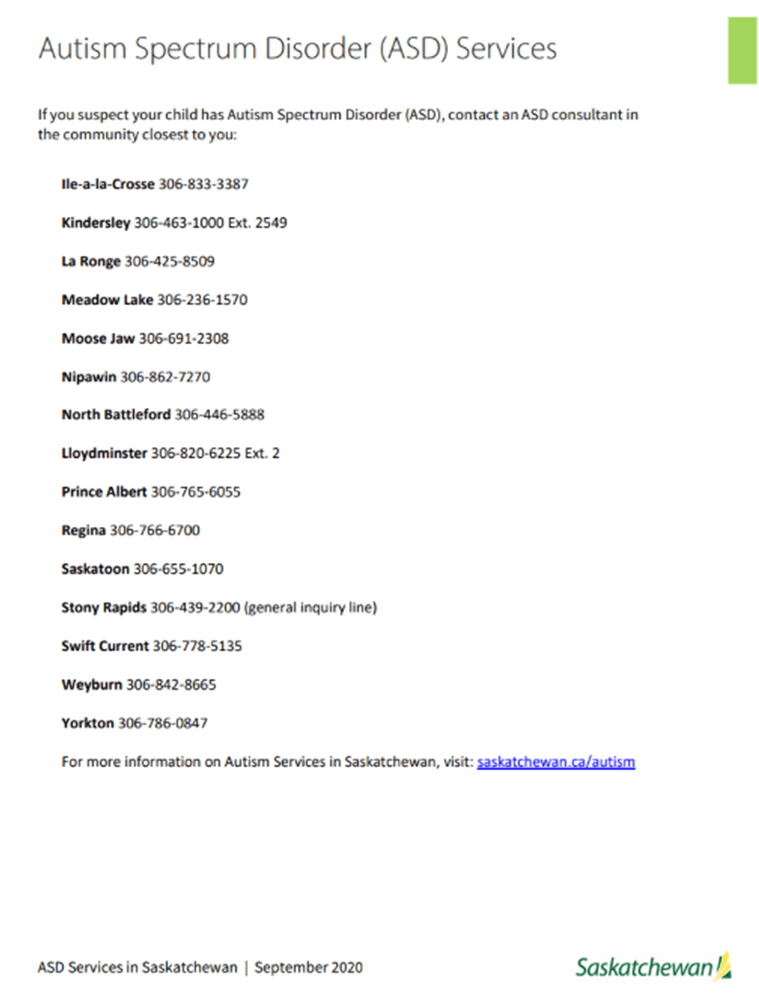
(NOTE: These numbers were accurate as of August 2023. To ensure accuracy, check this link:)
In my experience, it is best to call these phone numbers directly. While your family doctor is supposed to be aware of this service and make referrals to it, some are not, and can waste your time by making referrals to other medical professionals, such as pediatricians or private psychologists. Others choose not to make referrals, because their understanding of autism is out of date, and they don’t recognize the signs. Again, if the above information has you strongly considering autism, cut out the middle man, and go right to the Autism Services program.
The Autism Services program will walk you through various screenings and will refer you to their psychologist on staff if your child is scoring high on the various tests. They can also make referrals for you to other practitioners, such as speech pathologists, if their screenings show that this could be helpful.
In addition, this program can also set you up with an early intervention support worker who can come to your home and work with your child if they are a toddler or preschool-aged and not yet receiving supports through school. If your child scores high enough on the screening tests, they are eligible to work with the support worker even before the diagnosis becomes official. (The official diagnosis process can take some time, since it involves multiple tests and different practitioners. Thankfully, your child doesn’t have to miss out on early intervention while you go through the process, thanks to this program!)
It’s Definitely Autism
If you’ve made it through the diagnosing process, there are programs you should know about.
- Autism Services
Hopefully, you are already working with Autism Services. However, if you are new to the province, or received a diagnosis without the help of Autism Services, reach out to them now with the phone numbers above.
Your child may still qualify for a support worker until they are in school. After school begins, your worker largely hands you off to the school team, however, they are still your ally if you need them. My son’s autism support worker attended various meetings at his school with me to help me advocate for my son’s needs, and make helpful suggestions for the school.
Autism Services also often has a social worker on staff who can help you sign up for the various benefits and programs in your area.
- Saskatchewan Individualized Funding for Autism (IF)
The Saskatchewan IF program is a provincial government program that grants tax-free allowances to families with autistic children.
If your child has an official diagnosis, you can apply for this annual allowance until they are 11 years old. This allowance may be used for speech therapy, occupational therapy, equine therapy, therapeutic equipment, private swimming lessons, and more. This allowance is free through the provincial government, and the only “catch” is that you must keep track of your expenses so they can be reviewed annually. The program provides a list of eligible expenses, and a list of eligible practitioners in the province.
(Tip: If you are not part of the IF program, you can still access the list of practitioners here. You can search the list by city to find a good speech pathologist, social worker, etc… near you.)
- Community Living Service Delivery (CLSD)
CLSD is a branch of the Ministry of Social Services and supports individuals with intellectual disabilities. Your autistic child may qualify for support through CLSD if they also meet a certain threshold of intellectual delay.
CLSD offers a number of services including day programs and respite programs. As your child grows to adulthood, CLSD is who can help you with living options such as group homes or assisted living.
- Disability Tax Credit (DTC)
The federal government of Canada has a Disability Tax Credit available to individuals with disabilities (or their guardians, if the person is not an adult). This is available across Canada, not just in Saskatchewan, and supports individuals with various disabilities, not just autism. The DTC reduces the amount of income tax you pay each year. The purpose of this tax credit is to off-set some of the costs you may incur due to various therapies, medical travel, etc… Autistic individuals, or their caregivers can apply for this tax credit with the link above.
- Registered Disability Savings Plan (RDSP)
Another federal service available to autism families in Canada is an RDSP. You may have heard of an RRSP (Registered Retirement Savings Plan), or even an RESP (Registered Education Savings Plan). The RDSP (Registered Disability Savings Plan) is similar. It is a savings plan specifically for individuals with disabilities.
Parents/legal guardians may set up an RDSP for a child to help provide for their care into adulthood. If you are eligible for the Disability Tax Credit, you are also eligible to set up an RDSP.
The federal government makes certain financial contributions to RDSPs, including contribution matching, up to $3,500 per year. (Accurate as of August 2023)
Out of Province?
If you are not from the province of Saskatchewan, but are looking for information like this, keep in mind that the federal programs listed above (DTC & RDSP) are available country-wide. You can also google “Government of (province/territory) + autism” to find programs supported by your provincial government. By adding “government” to your search, you are more likely to find free services provided by your provincial health regions, and less likely to find expensive private solutions.
I hope this information makes your journey a little easier.
© 2023 Ashley Lilley – First time commenting? Please read my Comment Policy.
Discover more from Ashley Lilley
Subscribe to get the latest posts sent to your email.


One caveat about the Disability Tax Credit (and therefore also the RDSP as you have to qualify for the first to qualify for the second): it is not based on the diagnosis, but on how limiting the disability is on daily life. And it has to be pretty severely limiting before they’ll let you qualify. And the instructions on the form are misleading. They make it sound like they accept a lot more people than they actually do. So there’s a large percentage of the disabled community (including those who have been deemed “unemployable” by the ableist society we live in) who don’t qualify, but who also can’t financially support themselves.
LikeLike
Yes, it is based on severity. Not everyone will qualify, but it’s worth knowing about and applying for. I think it’s a shame that some people who could really benefit from the DTC, or similar, don’t even know it exists.
Also, I didn’t realize you were Canadian, Kim. So many of my readers are American. Welcome fellow Canuck! 🙂
LikeLiked by 1 person
It’s absolutely worth knowing about! 🙂. I’m just particularly disgusted with the governments about all their posturing about “look at me, I’m doing all this good stuff for this population or that population” and then you read the fine print and it’s actually only for a very small percentage of that population. And, as you say, apparently even with all the posturing, many people still aren’t even aware such things exist.
LikeLike
That frustration I can understand! My post next week is going to be a bit of a vent about things like that. 🙂
LikeLiked by 1 person
The one good change they’ve made (years ago now) to the Disability Tax Credit is that once you qualify, you qualify for life. Once upon a time they made you re-apply every year.
LikeLiked by 1 person