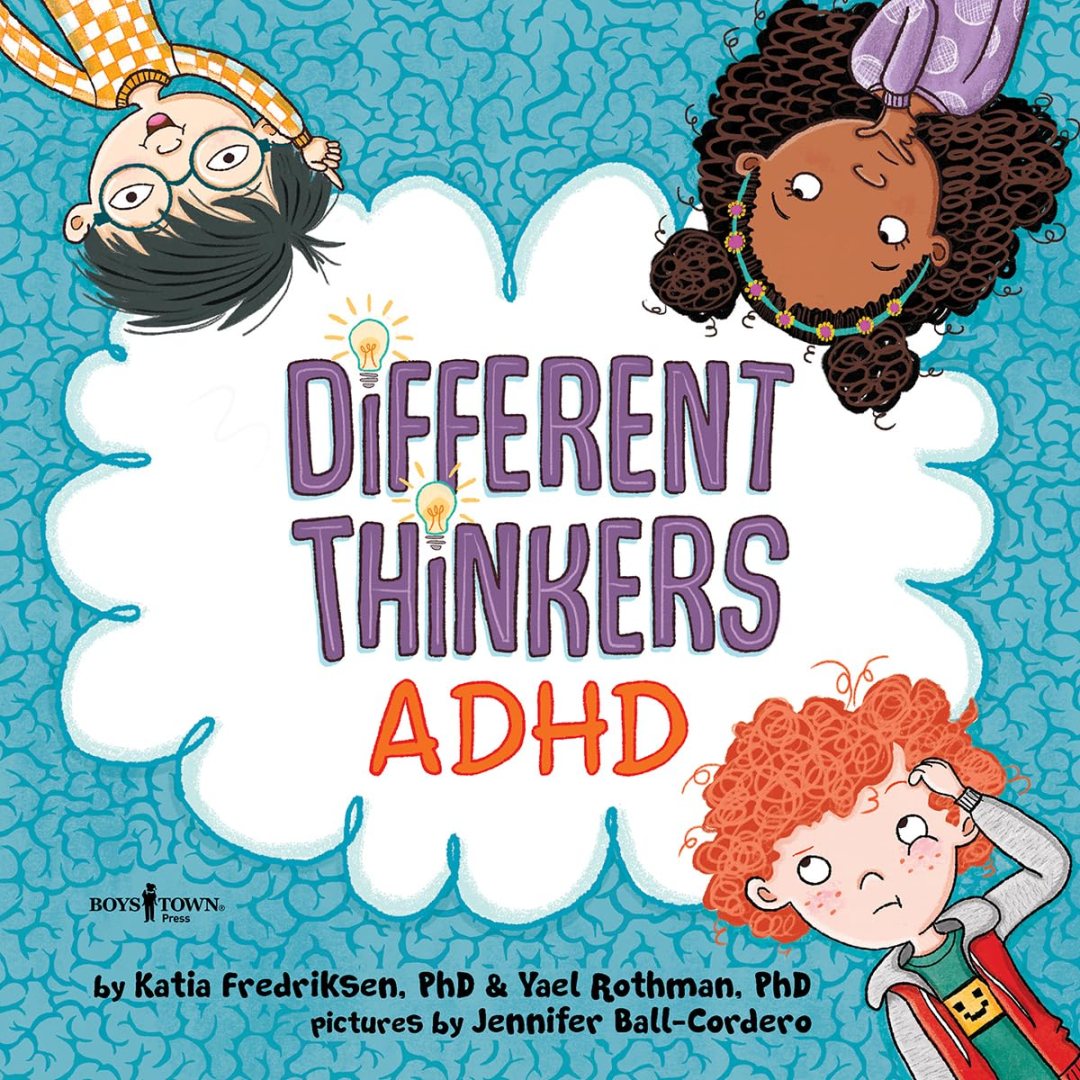
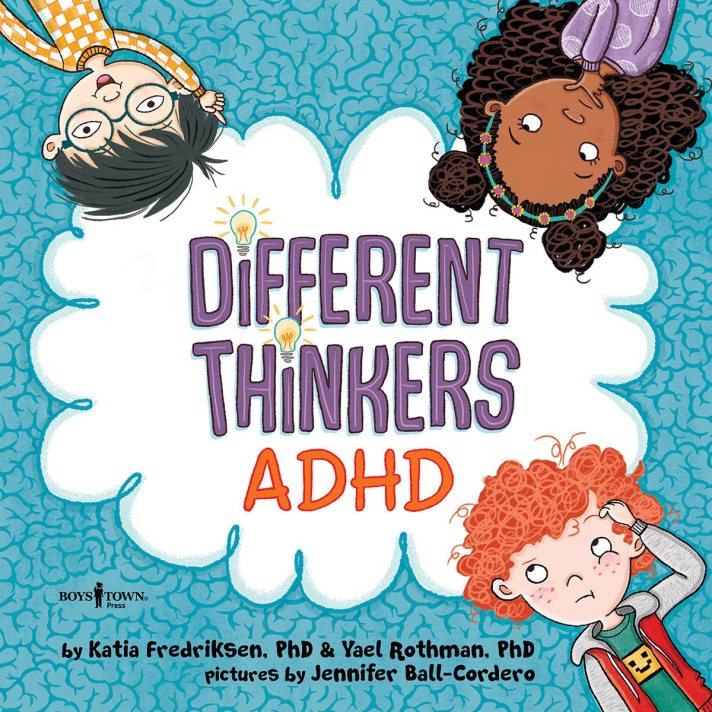
Different Thinkers ADHD
By: Katia Fredriksen PhD & Yael Rothman PhD
Illustrated By: Jennifer Ball-Cordero
Children’s Non-Fiction, Children’s Picture Book
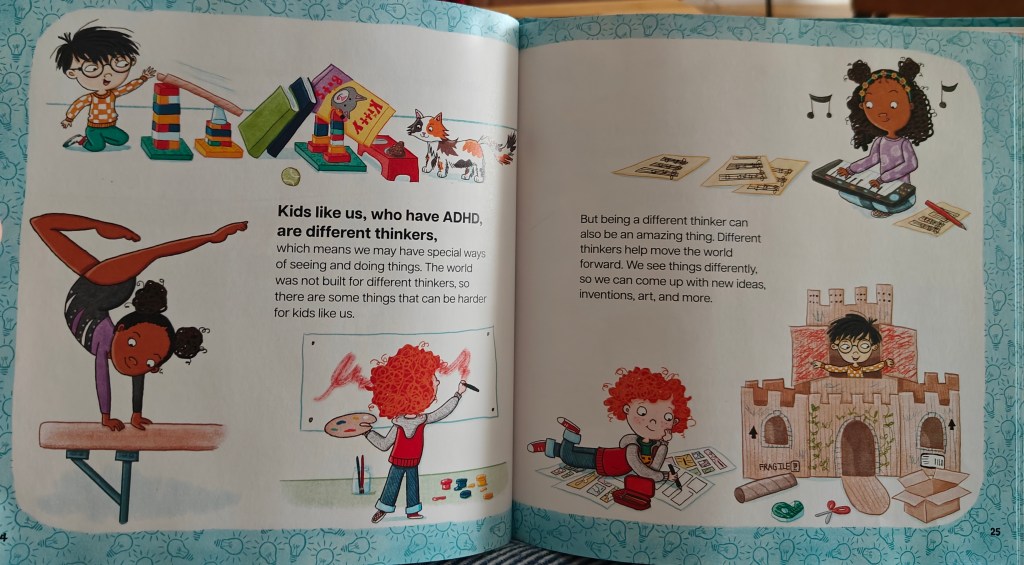
Different Thinkers ADHD is a book about ADHD for kids, written by a pair of pediatric neuropsychologists (the kind of doctors who diagnose ADHD and other neurodivergent conditions.) It gives a brief introduction to brains and how they work, followed by examples of how an ADHD brain functions differently than a typical brain. It lists many positives aspects of ADHD and encourages kids to think of their own unique, positive attributes. It also lists some of the challenges that ADHD-ers face, shares ideas of how to build skills in challenge areas, and encourages kids to think of more ideas that will be uniquely helpful to themselves.
Credits (The Good Stuff):
- This book is neuro-affirming, which means it frames ADHD as a brain difference (not a disease or deficit), and it doesn’t stigmatize people diagnosed with ADHD. It even teaches kids exactly which parts of their brain work differently, which is very interesting and empowering information.
- This book uses thoughtful, positive language throughout. While some ADHD books talk about fixing ADHD’s deficits, or symptoms, this book encourages kids to build skills in areas that are challenging. It is an empowering approach that was obviously chosen with thought and care.
- This book shows how a psychologist would go about diagnosing ADHD (by utilizing a lot of games and hands-on activities). This is something many other books don’t touch on, and I think it’s a great addition. It can clear up a lot of mystery/anxiety around the process for kids and parents alike.
- The book introduces different profiles of children with ADHD, showing how ADHD can look a little differently from person-to-person.
- This book was designed to be interactive, by asking the reader questions, providing space for kids to write lists, and including a Parent/Teacher section that gives adults tips on how to talk to kids about ADHD.
- There is multicultural representation in the illustrations.
Cautions (Be Aware/The Bad Stuff):
I don’t have any glaring objections to this book. Just a few things that I wish were a little different.
- The book mentions that ADHD looks different in boys vs. girls. This is somewhat true, but it is an overgeneralization/stereotypical statement that I wish society as a whole would move away from. While boys are statistically more likely to be diagnosed with a hyperactive presentation of ADHD, and girls are statistically more likely to be diagnosed with an inattentive (ie. internalized) presentation of ADHD, not everyone fits this mold. If people are conditioned to believe that boys and girls only show one type of ADHD, then kids who present differently are more likely to be misunderstood and missed. There are plenty of boys out there with inattentive ADHD, plenty of girls out there with hyperactive ADHD, and an entire category of people of all genders with combined-type ADHD. I think it’s important for parents, teachers, and family doctors to learn how to recognize all the various signs of ADHD without preconceived notions of who “can” or “can’t” have them.
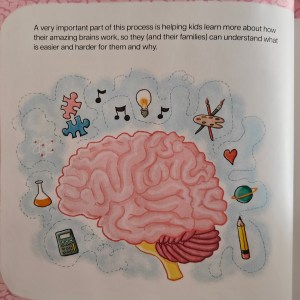
- I spotted puzzle pieces in one illustration about brain differences. (pictured above) I don’t believe they were intentionally used as a representation of autism, but just a head’s up.
- This book briefly mentions the use of sticker charts for good behavior at school, which is a practice that is coming under scrutiny.
- While the illustrations include racial diversity, they don’t include any diversity in body size (everyone is an average height and weight), or include anyone with a visible disability (other than wearing glasses.) This doesn’t mean that I think this book is bad; it’s hard for a single children’s picture book to cover all of the things. This is just a wish-list item I look for that this book didn’t meet.

Conclusion:
In the past, I have had bad luck with books written by medical professionals. Many of them talk about ADHD like it’s a disease that needs to be cured, and unintentionally (or sometimes intentionally) shame kids for their struggles. Others have been too technical and full of jargon to be kid-friendly. I am very happy to say that this book avoids all of these pitfalls!
This book in incredibly educational/informative, while presenting the information in an understandable and kid-friendly way. It’s bright, interesting, interactive, and presents a positive and empowering view of ADHD throughout.
I can definitely give this book a big thumbs up, and recommend it for clinical, classroom, and home reading.
©Ashley Lilley
This blog was written by a human being (me!) without the use of generative AI. I do not consent to having my work used for AI training purposes. Thank you for supporting human writers.
First time commenting? Please read my Comment Policy.
Discover more from Ashley Lilley
Subscribe to get the latest posts sent to your email.

