

When I buy a book for a child, I hope that it will be read, re-read, and enjoyed. I try to put careful thought into book purchases, so they don’t end up forgotten on the shelf.
Last week, I wrote about six criteria I use to help me pick a great book. This week, I’m reviewing three books and picking “the winner” for one of my sons. Check out part one HERE.
About the Reader
Today I’m picking a book for an 11-year old whose favourite stuffy is a panda. He is autistic and ADHD. He is hyperlexic, which means he loves letters and is fascinated by creating words with letters. Yet despite this fondness for words, he actually struggles quite a bit with reading comprehension. (While he is great with individual words; he struggles to make sense of a large piece of text as a whole when all of those words combine.) He also has a very short attention span, which often keeps him reading below grade level. He likes books that are bright and engaging, and loves a good joke or a bit of silliness.
See if you can guess which book I picked for him!
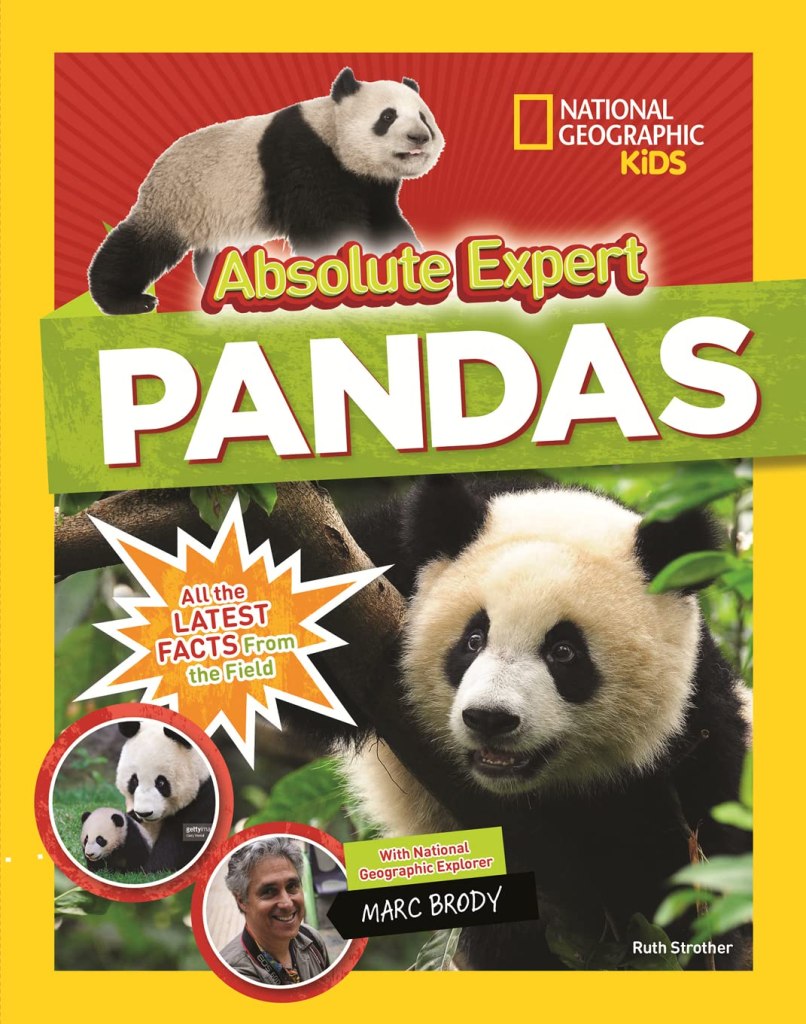
Absolute Expert: Pandas
by National Geographic Kids with Marc Brody & Ruth Strother
Pages: 112
Recommended Age: 8-12 years
Recommended Reading Level: Grade 3-7
Hardcover
Content:
The Absolute Expert panda book definitely lives up to its title! It is absolutely packed with information: from the physical characteristics pandas, to their life cycle, to their environment and diet, to a history of pandas both in the wild and in zoos, to the conservation measures that helped move them off the endangered species red list. This is a highly educational book that will provide plenty of new information to kids and adults alike.
Style:
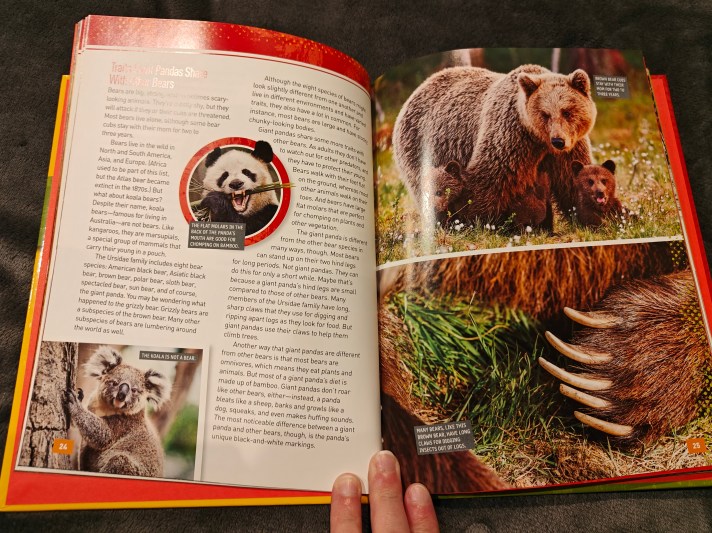
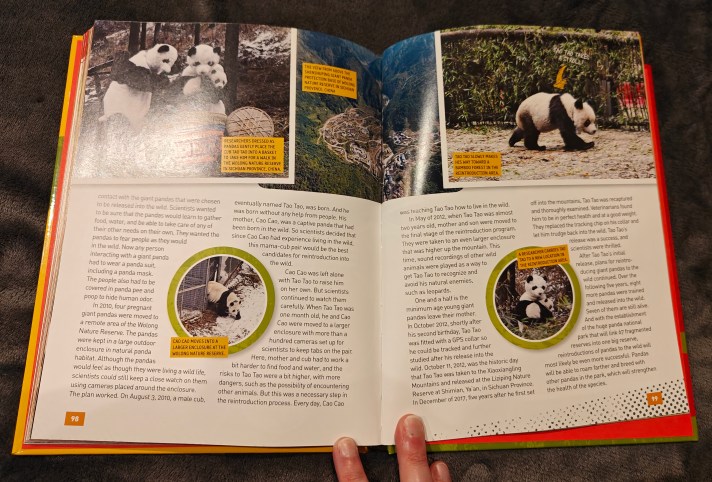
This book reads like a textbook, but the photos and full-colour backgrounds keep it appealing. The language style does not “talk down” to readers. It feels very much like a “big kid” book for smart, inquisitive kids.
Text:
The body text size is pretty small: about a 10/12 pt font, like you’d see in an adult book. There is some breakout text in this book, and many photos have captions, but the majority of the text in this book is body text. Most of the pages are broken up by pictures, but a couple pages are a full wall of text. This book is divided into 4 large sections of 20+ pages each.
Illustrations: This book is illustrated by beautiful, full-colour photographs. There are no shortage of pictures. The pages keep a pretty good 50-50 split between photographs and text.
Engaging Features & Gimmicks:
Each of the four sections end with a “Panda-Mazing!” two-page activity. One is a quiz, one is a craft, one is an outdoor activity, and one is a recipe.
Conclusion:
National Geographic is a brand that has become synonymous with high-quality, engaging educational material that kids, parents, and teachers know they can trust. This is the kind of book that you could proudly use and cite when researching a school report.
Because this book is so long, and contains so much body text in a small size, it isn’t the ideal book for my kid. However, I would rate this title as the most thorough and educational of the bunch. So, if you have the kind of kid who devours books, or one who isn’t intimidated by big books if they are about their favourite subject, this might be the right one for them.

All Things Pandas For Kids
by Animal Reads
Pages: 78
Recommended Age: 6-12 years
Recommended Reading Level: None Listed
Paperback

Content:
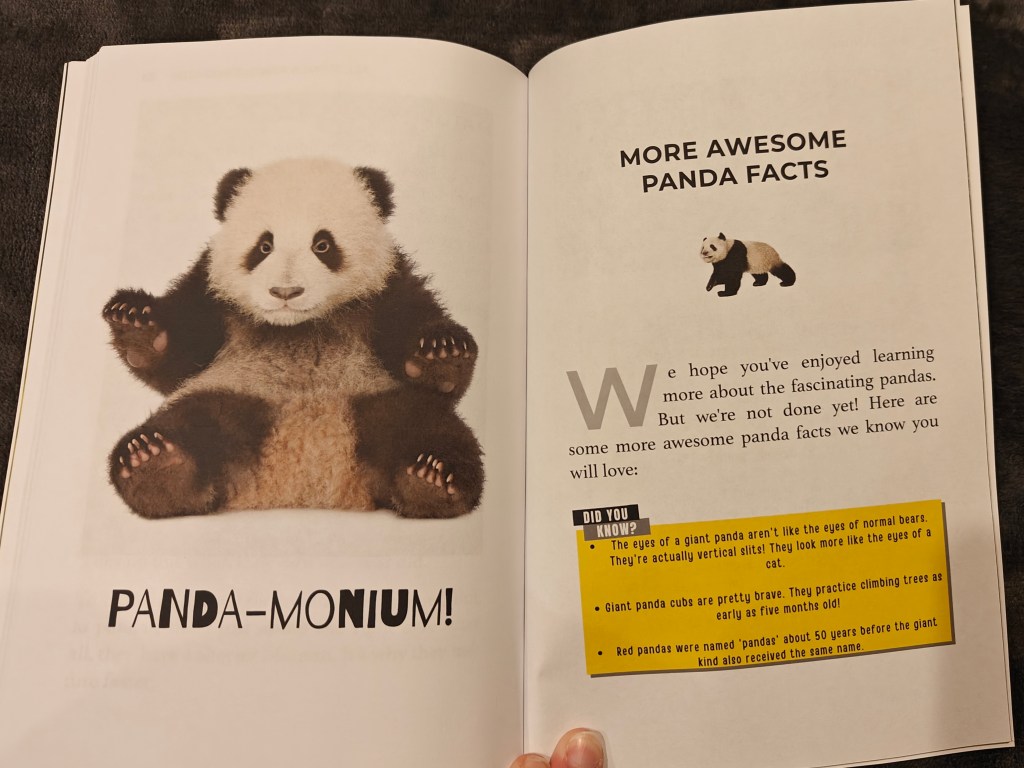
This book gives a general overview of pandas, with a large focus on the differences between giant pandas and red pandas. It contains the least amount of information of the three I’m reviewing.
Style:
This book has a slightly more “story”/conversational feel to it than the National Geographic book above. It sort of feels like reading a blog post. The language of the book is a bit of a mixed bag. The sentences and paragraphs are short, but the vocabulary words are large. It feels like it is written in a Grade 2-ish format, while using Grade 4-ish vocabulary.
Text:
The font size is approximately 18/20, which is a great size for young readers. It is easy to see and follow along. There is only one instance of text on a coloured background; the majority of the book has clear text on a white background. The book is divided into 9 chapters that average about 6 pages each. Each chapter is divided further with sub-headings.
The majority of the book is body text; there is only one box of breakout text in the whole book. However, the book does make use of pictures to break up the text every 2-4 paragraphs.
Illustrations:
The illustrations in this book are full-colour photographs. There are a few full-page pictures, but most of the pictures are quite small. The text to photo ratio feels about 60-40, with the text taking the larger portion.
Engaging Features & Gimmicks:
This book ends each chapter with a panda joke or pun. It also mentions the movies Kung Fu Panda, and Turning Red as a way of relating the panda information to films its readers may already know and love.
Conclusion:
This book has a lesser-quality feel. The combination of paperback, small images, and practically no breakout text, reminds me of the leveled beginner reader books that kids get sent home with from school. (The ones made on the school’s office printer.) So, as far as the gift appeal goes, this one feels underwhelming (especially considering that it’s nearly the same price as the others.)
To its credit, this book is great for kids who may be reading below their grade level, as the format is simple, but the vocabulary is challenging. Plus, this book is the most dyslexia-friendly of the lot, with its clear text and ample use of white space.
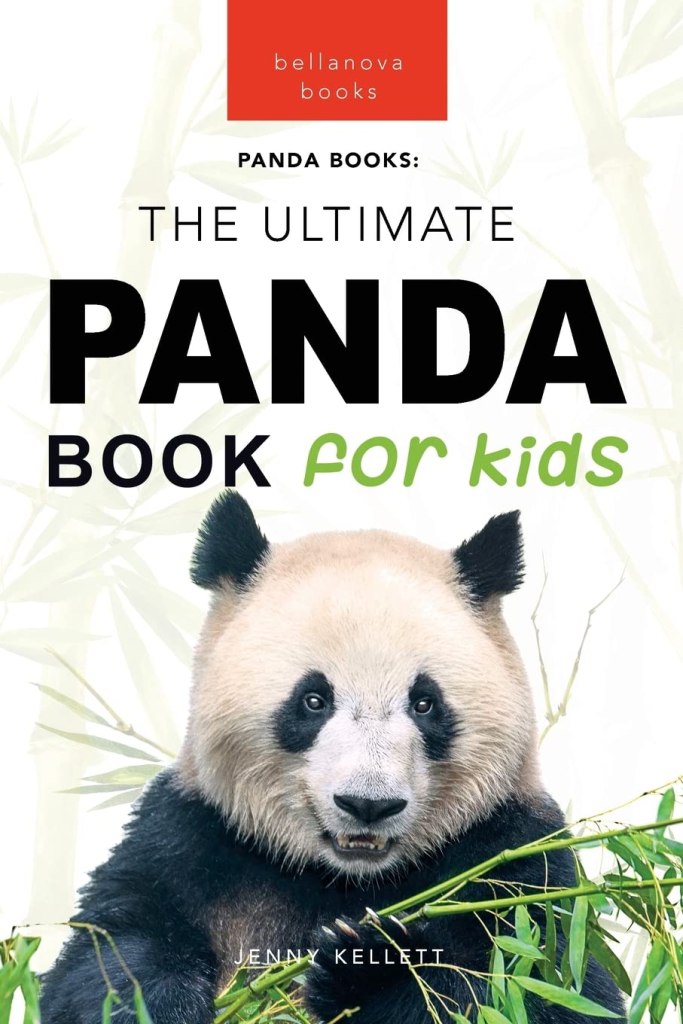
The Ultimate Panda Book for Kids
by Jenny Kellett
Pages: 78
Recommended Age: 9-12 years
Recommended Reading Level: None Listed
Paperback


Content:
This book is a collection of “fun facts.” It contains more information about pandas than All Things Pandas, but less than National Geographic. The focus of this book seems to be more on novel/interesting facts (such as how many teeth pandas have, or how often they poop), than a detailed background about their habitat and lifecycle.
Style:
There is no “story” connecting all of the information together. Rather, this book is a series of short easily-remembered snippets. It kind of reads like a series of “Tweets” about pandas. The vocabulary is about Grade 4+, but the unique spacing makes this book very simple and digestible.
Text:
The text size is about 18/20, so it is very large and visible. The majority of the text is on a white background, or a minimalistic light-coloured background (there is a faint pattern of bamboo leaves on many of the pages.)
There is no breakout text in this book (no little boxes or captions), but the body text of this book is divided up in a way that I haven’t seen done before. Each “fun fact” is separated out and stands alone. In essence, the entire book is breakout text, which means readers are never more than 1-3 sentences away from a break!
Illustrations:
This book is also illustrated by full colour photographs. The photos are larger and nicer quality than the book above, but the text to photo ratio feels about the same: 60-40.
Engaging Features & Gimmicks:
In many ways, the entire book is an engaging feature, since it is a collection of facts, instead of a narrative. This book also contains a panda-themed wordsearch, and a quiz to test your knowledge at the end.
Conclusion:
This book seems to fall in the middle between National Geographic and All Things Pandas in almost every respect. It is in the middle in terms of educational value, engaging content, and quality-looking/value for price.
However, this book ranks #1 for catering to a struggling or reluctant reader.
The lack of a cohesive story may be frustrating, or even seem low-quality to an adult reader, but that is what makes it great for a reluctant or struggling reader. A child need only maintain their focus and work hard for 1-3 sentences. That’s it. After 1-3 sentences, they could put the book down and take a break, and already have an interesting panda fact in their mind! There is no need for them to struggle through pages of background information before they actually “learn something.”
Verdict
Can you guess which one I picked?
The Ultimate Panda Book for Kids is the winner for my son. It may not be the one that stands out as “best” in a bookstore, but it is the one that I think will engage him and make him want to read it. And isn’t that the point?
In my opinion, the best book is one that is read.
©Ashley Lilley – First time commenting? Please read my Comment Policy.
Discover more from Ashley Lilley
Subscribe to get the latest posts sent to your email.
 Ashley Lilley
Ashley, you put so much into finding the right stuff, the right things, the right books your kids. I’m very impressed. You’re a wonderful mother, you really are! Also, I’m pleased to say, that after reading your reviews l picked the right book. Okay, l had a 33 percent chance of getting right, but l did get it right. lol
LikeLiked by 3 people
Haha, well done!
LikeLike
This is so good! I would have chosen The Ultimate Panda Book for Kids for my daughter, Kitty, also. It is uncluttered with large photos and she can read just one or two sentences at a time and still get a lot out of it. Beautiful post!
LikeLiked by 1 person