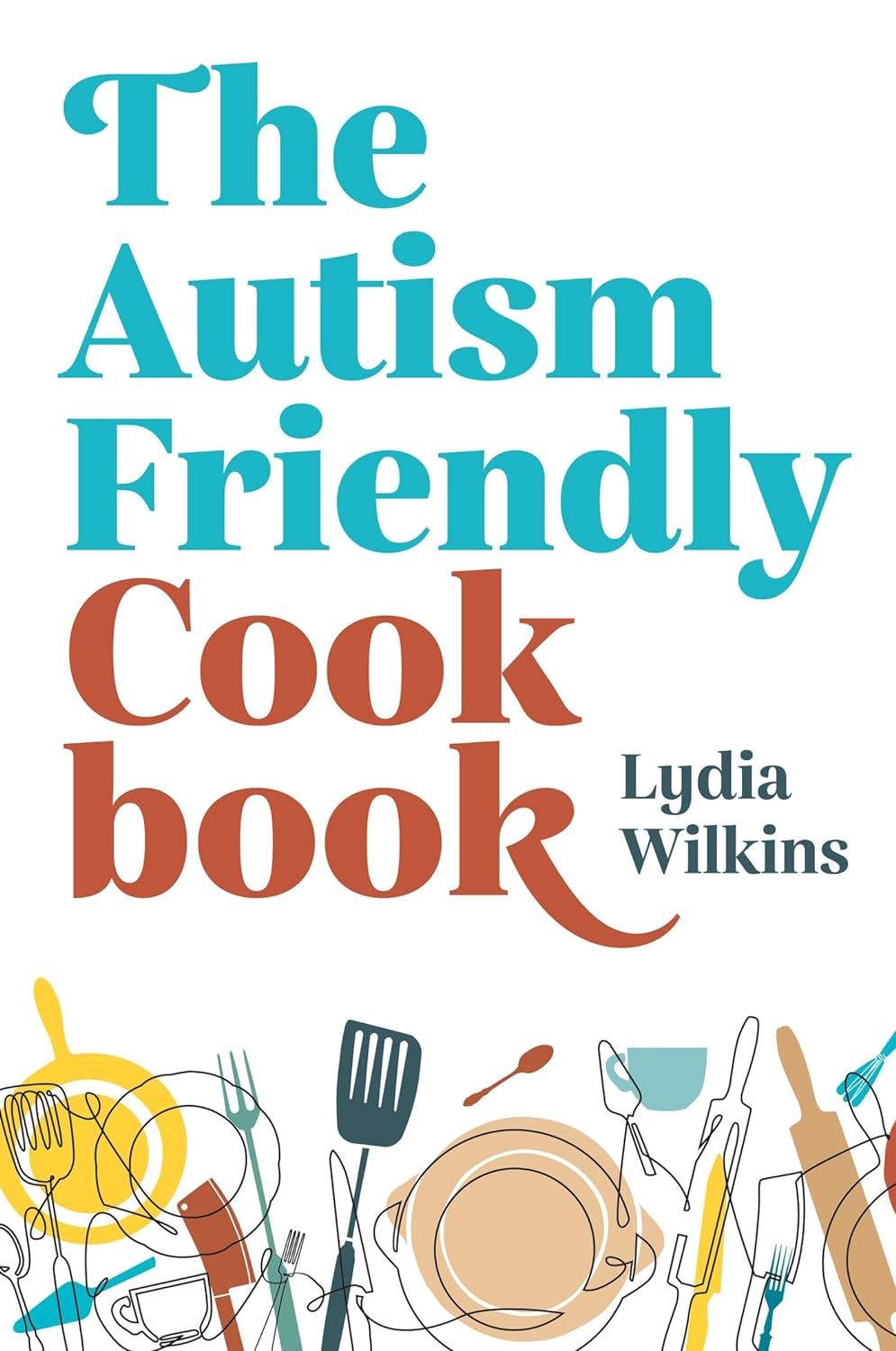

The Autism Friendly Cookbook
by Lydia Wilkins
Cookbook
I was very excited to get my hands on a copy of The Autism Friendly Cookbook because it is unlike any other cookbook for autism out there.
Most cookbooks for autistics, aren’t autism-friendly at all. They contain all the usual cooking terminology without explanation, and never take into account that most of their recipes are far too multi-stepped and timing-dependent for anyone with executive function challenges. The only thing that makes these cookbooks related to autism whatsoever, is the claim that the miracle diet found in their pages will cure autism. *insert eye roll and exasperated sigh here*
This book, by an autistic author, changes all that. There are no miracle cures, or weird ingredients here! It is just good, simple food with good, simple instructions to help those on the spectrum learn to cook and to feed themselves.
Here’s a peek at what you’ll find in The Autism Friendly Cookbook:
- An introduction that offers some wonderful advice to new cooks, including: “There is no shame in not knowing something,” and “Cook for yourself—and not for the approval of others.”
- A section for Parents/Caregivers/Teachers with tips for making the kitchen, and the experience of cooking, more comfortable.
- A large section of definitions of cooking terms, and detailed descriptions of common cooking tools.
- A list of alternative ingredients, perfect for allergy substitutions.
- A visual recipe “Key” at the top of each recipe, sharing a ton of category information at a glance. This key includes what you may expect: Vegetarian, Vegan, Gluten-Free, and
Dairy-Free; plus many other categories that you have never seen anywhere else:
-Sensory-Seeker-Friendly,
-Sensory-Avoider-Friendly,
-A “To Make When” section offering suggestions of when to prepare each meal (such as, on low-energy days, or to serve to guests),
-And a Low-to-High Energy Indicator to show how much time and effort each recipe will take to prepare. - Every recipe contains a list of ingredients, a list of all cooking tools required, and a section called “Expand Your Repertoire” with ideas for substitutions and additions.
- Each recipe has very detailed instructions, including the steps that most regular cookbooks leave out. (Examples: discard the avocado pit; keep the stalk to cook with, but throw away the leaves; etc…)
- There is no food shaming here! The recipes in this book are all about nourishing the body. Nothing fancy. Nothing complicated. Nothing pretentious.
- This book makes no assumptions about someone’s previous kitchen experience. There are even recipes for classics such as beans on toast, and peanut butter and banana slices on toast, for the kitchen beginner.
- Every recipe is made as simple as possible, by making use of prepped and packaged ingredients, such as microwave rice, and bags of pre-shredded cheese.
I have nothing bad to say about this book. Only a small caveat: This book is written in European English, which means some dialect differences which may be confusing (ie. aubergine vs. eggplant, hob vs. cooktop). There are also a couple recipes that will appeal to European palates more than North American palates (ie. leg of lamb isn’t standard fare in small-town USA & Canada). That’s it. That is the only critique I can come up with. And even then, the author has done her best to accommodate these differences by translating many of the terms, and listing both metric and imperial measurements for each recipe.
If you are a late-diagnosed autistic that has already been cooking for yourself or your family for years, this book may be too simple for you. However, I wholeheartedly recommend it to families with autistic teens who are looking to increase their independence, high schools or occupational therapy centers that offer life skills classes, and group homes/independent living programs.
Well done, Lydia Wilkins!
©Ashley Lilley
This blog was written by a human being (me!) without the use of generative AI. I DO NOT CONSENT to having my work summarized by AI, or used for the purpose of training AI. Thank you for supporting human writers.
First time commenting? Please read my Comment Policy.
Disclosure: No affiliations here! While this page may contain links to products, I am not an affiliate or ambassador for any brand. I do not receive commission or kickback of any kind for recommending products. Just sharing stuff I love, and hope it helps someone. If you wish to support my blog in some way, please consider following me on social media and sharing my links with your friends. -Ashley
Discover more from Ashley Lilley
Subscribe to get the latest posts sent to your email.
 Ashley Lilley
How wonderful to find a gem of a cookbook! Thank you for sharing it.
LikeLiked by 1 person
As an Aussie I grew up eating lamb and I was surprised to learn (after being married to an American) that it’s not popular in the US. But since having pet sheep who I love dearly I no longer eat lamb. I can’t even buy dog or cat food made from sheep 😉
LikeLike
Thanks for the recommendation! I may have to look it up at some point!
LikeLiked by 1 person