
Before the summer break, I mentioned that I have been diagnosed with ADHD-Type I, and received this comment on the post:
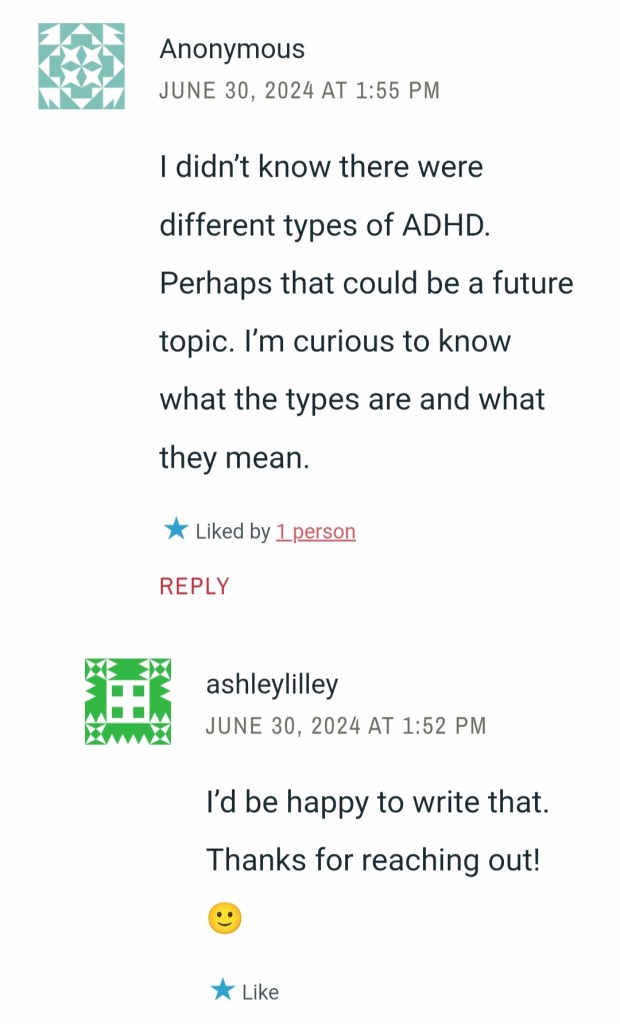
The comment said: “I didn’t know there were different types of ADHD. Perhaps that could be a future topic. I’m curious to know what the types are and what they mean.
I love hearing from readers, and welcome suggestions, so I’m very happy to introduce the topic of the different ADHD types today.
History of ADHD
The definition/classification of ADHD has evolved over the years as psychologists and researchers have learned more about how ADHD affects the brain, and how different ADHD behaviors can manifest in different people.
The term “ADHD” was coined in the 1980’s, but it has been observed and called by other names for centuries. Fun Fact: one of the first printed mentions we have of ADHD was in a medical text from 1798! The author called it a “mental restlessness,” and described it as “having the fidgets.” Other names for ADHD over the years have been “Minimal Brain Dysfunction,” and “Hyperkinetic Reaction of Childhood.”
In the eighties, ADHD was separated into two separate conditions:
1. ADHD, which stands for Attention Deficit Hyperactivity Disorder, and
2. ADD, which stands for Attention Deficit Disorder (the same thing, minus the hyperactivity).
In 2013, the DSM-V* changed the terminology around ADHD again. It combined ADHD and ADD into one single disorder. However, it also recognized three different presentations of the disorder:
1. Primarily Hyperactive-Impulsive (Commonly known as ADHD-HI, or “Type H”)
2. Primarily Inattentive (Commonly known as ADHD-I, or “Type I”)
3. A Combined Presentation (Commonly known as ADHD-C, or “Type C)
These three types of ADHD are still diagnosed today.
*NOTE: “DSM-V” stands for Diagnostic and Statistical Manual of Mental Disorders, Version 5. It, and it’s slightly updated version (the DSM-V TR), are currently the official guidebooks for diagnosing mental disorders and illnesses in North America.
What Is ADHD?
ADHD is considered a neurodevelopmental disorder. This means that it affects the typical development of the brain and/or nervous system.
Someone with an ADHD diagnosis will show developmental delay particularly in the area of executive function. This difference in executive function ability will often look like hyperactivity, restlessness, impulsivity, inattention, or poor emotional regulation.
I wrote a five-part series on executive function: what it is, how to develop it, and how to support someone with an executive function disability (like ADHD), earlier this year. I recommend checking it out if you’d like more information on how ADHD affects the brain.
The Three Types of ADHD
Hyperactive-Impulsive ADHD
Someone diagnosed with ADHD-HI will often display the most “classic” or commonly-recognized characteristics of ADHD:
– hyperactivity
– impulsivity
– fidgeting
– impatience
While keeping in mind that everyone is an individual, and will show their ADHD uniquely, here is what a child with ADHD-HI may look like:
- A kid that is always “bouncing off the walls,” or getting in trouble for not sitting still or being disruptive in class.
- A kid that is often “mouthy,” argumentative, or “talks back.”
- A child that is physically destructive of things in their environment. (Even if they don’t mean to break things, they often do, simply by playing too roughly with them.)
- A child with limitless energy: they could be in sports 7 nights per week, and still never tire out.
- They may channel their energy into creativity: particularly comedy/drama/improv/impressions.
- They may get accused of “having a short fuse” or “overreacting” emotionally, becoming angry or bursting into tears over seemingly nothing.
- They may have no patience at all (usually with boring things like homework), or an unbreakable amount of focus and attention (usually just with one one or two specific things that they love: like video games.)
- They may get into trouble frequently for “acting out,” or “mouthing off.” Even when they know better, they just can’t seem to help themselves.
- They likely speak very loudly when they are excited, and are always getting told to “use their inside voice.”
Here is what that same child may look like when they are an adult with ADHD-HI:
- A “go-getter,” who always has a side job or a new hobby on the go.
- Someone who is “fearless” in risky ways: their hobbies involve skydiving, dirt biking, etc…
- Or someone who is “fearless” in a social way: they are always speaking their mind, dressing in eye-catching fashions, or otherwise drawing attention to themselves.
- They may often get called “the life of the party.”
- At work, they may be the “ideas person.” They always seem to come through with creative, “out of the box” solutions, however they rely heavily on the team to implement those solutions.
- They may act first and think later, as if they are completely unafraid of consequences.
- And they may be forced to deal with those consequences frequently: speeding tickets, minor infractions, drama in their family or friend group, offending people, getting fired/unable to keep a steady job, etc…
- They may have an addiction. This could be a socially-acceptable addiction like shopping, sweets, or caffeine; or it could be a serious problem with gambling, alcohol, or substances.
- They may be a natural “night owl,” who would rather party or work all night and sleep during the day.
- They may seem to be immune to the effects of caffeine, and can somehow fall asleep not long after drinking coffee or cola.
Inattentive ADHD
Someone with ADHD-I may fly under the radar and go undiagnosed for many years. This is because the busy, hyper-activeness that we associate with ADHD doesn’t really happen outside of the body for someone with ADHD-I. It happens inside their minds.
ADHD-I is often described as:
– inattentive
– distracted
– unfocused
but these characteristics describe what you can see on the outside. On the inside, an ADHD-I brain is often working overtime, which can be very overwhelming. This type of ADHD is frequently misdiagnosed as anxiety for many years before the correct diagnosis is found, as individuals with ADHD-I tend to be “worriers” and “overthinkers.” Later, someone with ADHD-I may a receive a diagnosis of depression. This is an extension of the poor self esteem that builds up over time in ADHD-I individuals. They begin to believe that they are fundamentally, “flawed,” “bad,” or “broken,” and fall into hopelessness.
While keeping in mind that everyone is an individual, and will show their ADHD uniquely, here is what a child with ADHD-I may look like:
- A child who is often quiet because they are lost in a daydream.
- A child who is surprisingly smart for their age: particularly in one subject at a time that they eagerly learn everything about.
- They may be avid readers who cannot be torn away from a book, or they may struggle to learn how to read at all.
- They may test higher than their grade level academically, particularly in the early grades.
- However, at the same time, they may make “careless” mistakes that seem beneath their ability, such as spelling errors, or skipping a question or section entirely on a worksheet.
- Around middle school, their report cards may start to say things like, “They could do better, if they weren’t always talking to their seatmate in class,” or “They have so much potential, if only they would apply themselves.”
- They may lose/misplace important things frequently: their homework, their band uniform, etc…
- They may be clumsier than their peers and gravitate toward non-athletic hobbies.
- They may have more fears and worries than other children their age.
- Their grades may begin to slip in high school, or they will maintain them by constantly stressing and worrying about school, working twice as hard as their peers.
Here is what that same child may look like when they are an adult with ADHD-I:
- Someone who “zones out” frequently during meetings or conversations.
- Someone who is often running late.
- Someone who is always having misadventures, such as losing their keys, forgetting important documents at home, or getting into fender-benders while driving.
- Someone who can’t quite commit to a hobby. They have tried so many things, but ultimately abandon each one.
- They might be that one friend who “has a sixth sense” about things. They can predict the outcomes of movies or books, and can read people exceptionally well (often picking up on bad intentions before anyone else.)
- They may get very excited about small details, working on them until they are absolutely perfect, while running out of time to finish the project as a whole.
- They are often embarrassed by their tendency to be late and forget things, and try to compensate by setting multiple alarms and reminders.
- They may become obsessed with self-improvement and buy things to help themselves, such as organizational tools, or self-help books. They likely have a whole collection of barely-used items that they were once absolutely sure would turn their life around.
- They may have a fear of failure, based on past negative experiences, and may avoid trying new things at all in order to save face.
- They likely struggle with low self esteem, and are particularly sensitive to being teased, even when it’s “all in good fun.”
- They may be chronically tired, and likely have difficulty sleeping.
- They may over-eat or over-caffeinate to compensate for their tiredness.
- They may be clumsy, or have mystery bruises from constantly bumping into furniture and door frames.
- They may frequently “go numb” emotionally, and become addicted to social media, or binge-watch tv. This is a way of quieting all the noise in their heads.
- They have very likely been diagnosed with anxiety and/or depression, or are exhibiting all the signs without getting help for it.
Combined ADHD
If the above lists of ADHD characteristics have you feeling exhausted, then you need to give kudos to the individuals with ADHD-C. Some people don’t just have Hyperactive-Impulsive ADHD or Inattentive ADHD, they have both.
Thankfully, most Combined-Type ADHD-ers will not have to contend with every single characteristic of both types, but they will have a significant mixture of both lists, combined in a unique way.
Sometimes, having a combination of characteristics can be to an ADHD-C individual’s benefit. If, for example, they are showing enough HI-Type signs, they may get noticed and diagnosed faster than their peers who just have I-Type signs.
However, having both can also be a disadvantage when it come to diagnosis, because some Type-C ADHD-ers have complimentary characteristics that allow them to stay hidden. For example: they may have a healthy dose of hypervigilance/overcompensation that usually develops in someone with Inattentive ADHD, which helps off-set some of the accidents or social missteps that would have occurred if they were only HI-Type. In this case, they may stay hidden until well into adulthood. This balancing act of carrying both types can be exhausting and confusing to say the least!
Thank you to the reader who asked about the different types of ADHD. I hope this post adequately answered your question!
If I ever touch on something you want to know more about, please let me know in the comments. I absolutely take requests! 🙂
©Ashley Lilley – First time commenting? Please read my Comment Policy.
Discover more from Ashley Lilley
Subscribe to get the latest posts sent to your email.
 Ashley Lilley
Thanks Ashley. You’re a warehouse of invaluable information and insight! Totally enjoy the rest of your day.
LikeLiked by 1 person
Thank you
LikeLike
Hmmm… As a kid (as young as I can remember up to 16) I remember being Type HI, but now I think I’m Type I with impulsivity. Well, I guess I’m hyperactive when I’m excited or there’s exceptionally more going on in my head than usual. I’d be curious to know if that’s Type C ADHD, or if that’s partly autism.
LikeLiked by 1 person
The categories aren’t completely exclusive. They just tell you which type you “predominantly” show.
It’s not uncommon for all ADHDers to have a mixture of HI and I traits. They’ll just tell you HI or I based on which one is the strongest. If there is no clear “winner” (ie. Your traits are pretty evenly spread) you’ll get a Type C diagnosis.
But yeah, it’s completely normal to have a spattering of traits from both sides. Every person is unique!
LikeLike