
Today I want to share something that has been bouncing around in my head for quite some time. It’s very important to me, so I hope you’ll stick with me to the end.
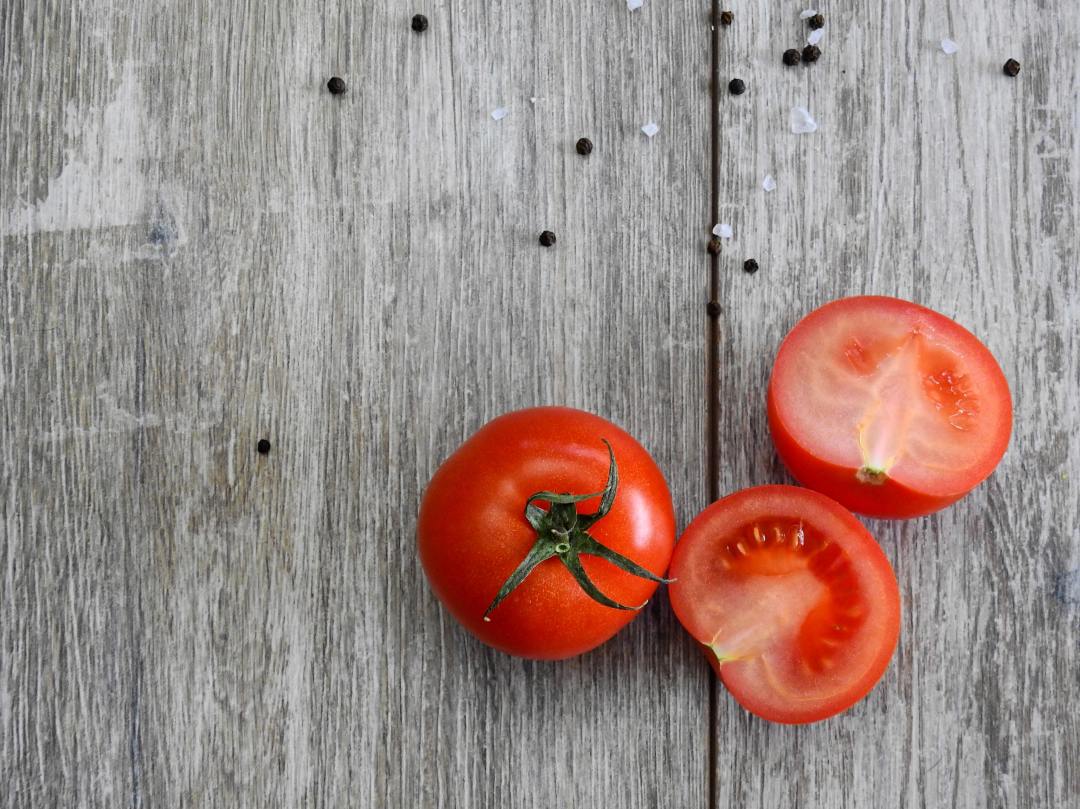
The pressing question I’ve been mulling over is this: Are tomatoes a fruit or a vegetable?
Seriously, which is it?!
I need answers, people! It can only be one thing. So let’s just pick one one and be done with it, once and for all!
Actually, as I am sure most of you know, tomatoes are considered both a fruit and a vegetable. Here’s why:
The scientific definition of a fruit is that it is basically the ovary of a plant. It’s soft and fleshy, and contains all the seeds. Therefore, if you ask a scientist what a tomato is, they are going to say it’s a fruit. If very clearly fits the description of a fruit, even to the untrained eye.
However, if you ask a chef (or anyone with taste buds for that matter), they are going to have the opposite opinion. Why? because it tastes like a vegetable. In terms of cooking, fruits are edible plant parts that are high in natural fructose and taste sweet. Therefore, they are usually used in desserts, or to sweeten dishes. Vegetables, on the other hand, are edible plant parts that have a low amounts of fructose. They taste savory, and are most frequently used as part of the main course.
And, if you ask a linguist what a tomato is, they are going to say it’s both. Webster’s backs them up.
Merriam Webster’s Dictionary
Fruit: noun
–the usually edible reproductive body of a seed plant
especially: one having a sweet pulp associated with the seed
–a succulent plant part used chiefly in a dessert or sweet course
–a product of fertilization in a plant with its modified envelopes or appendages specifically: the ripened ovary of a seed plant and its contents
In our wonderfully complicated English language, the definition of a word can change based on its usage. Context is required to understand the implied meaning of a word. Hence, Webster’s tells us both the scientific definition of a fruit, (it’s the seed sack of a plant) and the practical usage definition fruit (it’s pulpy, succulent, sweet, and used in desserts).
Then, just to make things fun, the United States Government got involved, having their say in the great tomato debate.
In 1893 the Supreme Court of the United States ruled that legally speaking, a tomato is a vegetable. Why? Because of the almighty dollar.
A Tariff act signed in 1883 had stated that imported fruits would not be taxed, and imported vegetables would be taxed. As you can imagine, tomatoes caused a bit of a problem. In the end, the Supreme Court ruled that since tomatoes are generally thought of as vegetables by the general public, and are used as vegetables, (and, just maybe, because it would be good for the government’s pocketbook), that tomatoes are a vegetable, and would be taxed as such.
Ok Ashley, thank you for the unnecessary history and grammar lesson. What does all this have to do with autism?
I’m so glad you asked.

Is autism a disability or a difference?
That’s going to depend on who you ask.
There is no shortage of concern, fear, debate, and even bad blood between autistic individuals, autism parents, medical professionals, and governments over what autism and being autistic really means.
The opinion of autistic adults is heavily influenced by their own unique experience with autism. Someone with low support needs who is able to work and live independently often, and understandably, has a different view than someone with high support needs who cannot work or live independently. Then, of course, there’s an entire spectrum of people in between.
Medical professionals and government agencies most often side with the idea that autism is a disability, because they are trained to see deviations from “normal” as a problem. A doctor will see autistic traits as a medical condition that must be overcome or cured. A governing body with its eye on the economy will reduce a person to dollars and cents; and, upon seeing that many autistic individuals are unemployed, under-employed, or using some sort of social assistance, they will put them squarely in the disability (liability?) category.
Parents of autistic children, and the children themselves, most often find themselves in some sort of hellish torture chamber, perpetually suspended between these complicated worlds of disability and ability. And, to further complicate their already difficult lives, they constantly get bombarded with messaging from both perspectives. They are pressured to “pick a side,” and decide if they will raise their child as disabled or independent. As if decision-making alone will determine the outcome of a genetic difference that was biologically decided before birth. What a cruel and unnecessary burden to put on people!
Many autistic children, regardless of how much support they will require when they grow up, require a significant amount of support in their early years. Getting a diagnosis is expensive. Then there’s everything that comes after it: speech therapy or communication devices, occupational therapy to help figure out sensory needs, feeding therapy or other nutrition interventions, and on and on. These helps are very costly, and the label of disability allows families access to programs and grants that make these things affordable. I can confidently say that my own son would not be so content and happy today, or making the steps he is towards independence, without the affordable support we were able to give him as a toddler. His success today was made possible because autism is considered a disability.
But then, there is the social side of life. The side of seeing autism as a difference.
My son’s early intervention caseworker once gave me the biggest compliment: “It’s easy to let yourself just see the autism… a problem to be fixed, or a puzzle to be solved. You are the only client I have right now that 100% sees your son as just a little boy.” Those were words I didn’t know I needed to hear! But I will hold on to them forever. My son was just a little boy. He’s still my little boy, (even though he’s 10 years old and quickly catching up to me in height.)
My son is different. He has different needs. He has different challenges. He has different interests and goals. His adult life may look different than his classmates’ lives will. But he is still a little boy. Still a human. Still a wonderful person who is worth getting to know. Still a unique person with so much to offer the world. If everyone could see him through my eyes, I have no doubt they would love him as much as I do. For this reason, I absolutely wish that the world at large thought of autism as a difference.
If you asked me today to declare if I am “Team Disability” or “Team Difference,” I couldn’t do it. Both perspectives have helped my family so much in different ways.
If the government and medical community did not consider autism a disability…
- we wouldn’t have been able to test my son and find answers to why he was struggling so much. He would have continued to be tortured by sensory and communication issues with no help or understanding from his family.
- there would be no books I could read with ideas about how to help him.
- there would be less therapy programs available, and none that are tailored specifically for autistic needs.
- there would be no financial aid available for therapies.
- there would be no disability savings accounts to help us save for his care after his Dad and I are gone.
- there would be no protections for him, allowing anyone who didn’t understand him to mistreat him or call him slurs.
For all these reasons, I want autism to be considered a disability.
However, when our family, friends, teachers, and community at large treat autism as a difference…
- fear and stigma gradually give way to curiosity and understanding.
- friendships get made.
- less bad assumptions get made, and kindness multiplies.
- other people begin looking out for my son when were are in public.
- people start acting more friendly around other disabled individuals, because of the knowledge and understanding they have gained from interacting with my family.
- the general knowledge and awareness of the whole community increases, and public places become more inclusive.
For all these reasons, I want autism to be considered a difference.
I’m sure by now that you have figured out where I’m going with this, but allow me to drive it home.
Autism does fit the category of disability. It also fits the category of difference. How you categorize autism will affect how you treat autism and the people around you who are autistic. Both views have their pros and cons, and both views have their place.
I wish that this debate over categorizing autism could be settled the same way we settled the tomato problem. Tomatoes are technically a fruit, but practically we treat it as a vegetable. Therefore, it is no longer either/or. It is both.
Could we all just agree that autism is technically a disability from a medical and legal perspective, while recognizing practically and socially that each autistic individual is a valuable human being who is simply different from ourselves?
I personally believe that autism isn’t an either/or. It is both. I also believe that you can choose to believe that too, if you want to.
We did it for tomatoes, Guys. Let’s do it for people.
©Ashley Lilley – First time commenting? Please read my Comment Policy.
Discover more from Ashley Lilley
Subscribe to get the latest posts sent to your email.
 Ashley Lilley
Great debate there! I think there are many facets involved like in precious gems. And people are precious (not the ‘one ring’ type of precious, but the value upon value kind.
LikeLiked by 1 person
Fantastic job Ashley!!!
Thank you!!!
LikeLike