

Time for another book review. Today’s book is great to read with/give to your autistic child.
Find my other reviews of autism books here:
Forever Boy
Parent Memoirs
Kids Books
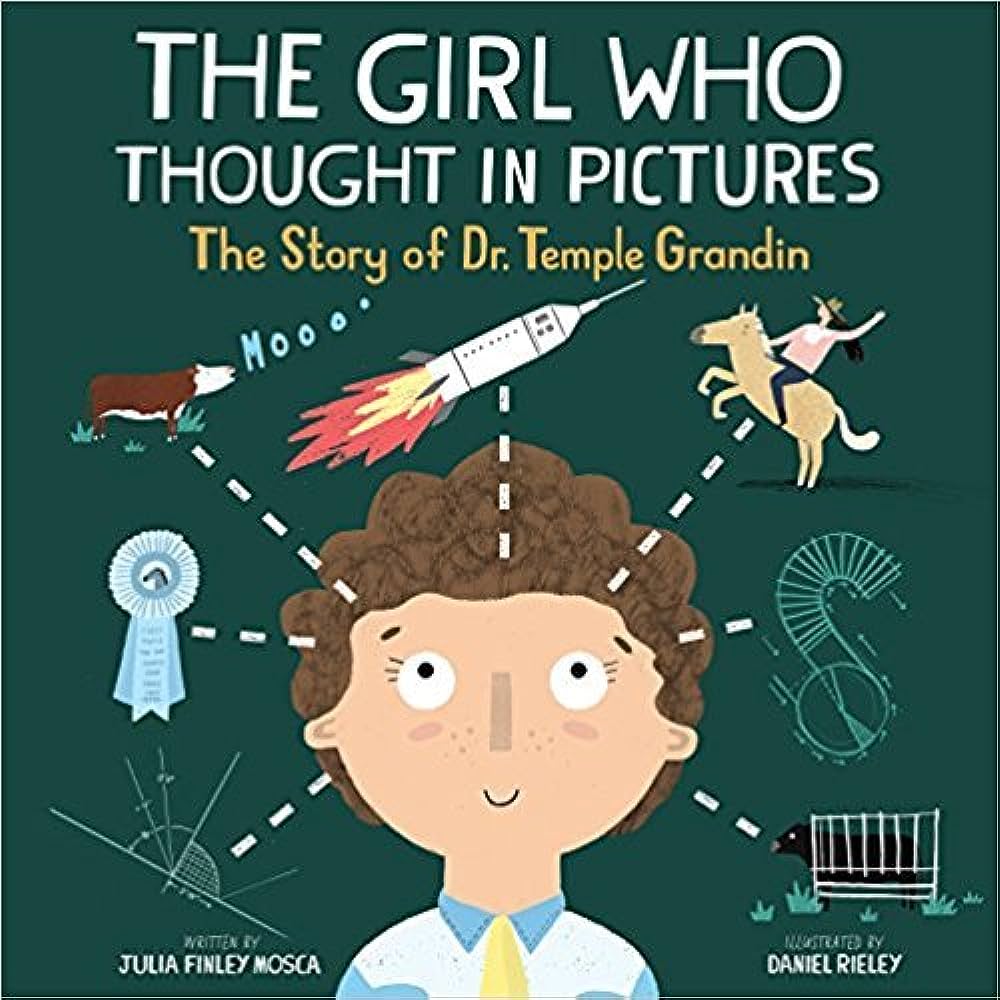
The Girl Who Thought in Pictures: The Story of Dr. Temple Grandin
by Julia Finley Mosca, Illustrated by Daniel Rieley
Children’s Non-Fiction, Biography
Every kid deserves to grow up with heroes and role models, and for many autistic individuals, that role model is Dr. Temple Grandin. Now in her seventies, Grandin is probably the most recognizable autistic trailblazer who grew up in a world that knew nothing of autism. While simultaneously having a career in the farming industry, she is also a famous autism advocate who has supported and championed early intervention and support for autistic children, citing the major influence of her mother and a teacher who accepted her and helped her unlock her potential.
“I am different, not less.”
-Dr. Temple Grandin
The Girl Who Thought in Pictures is a biography written in a poetic, rhyming style, with large, full-colour illustrations on every page. The story is only 30 pages long, and there are only a small number of words on each page, making it very engaging and readable for children.
I am having a little trouble recommending an age/reading level for this book, as the format lends itself well to young readers, but the text itself includes some pretty challenging words, such as unique, attention, and solutions. I think it works very well as a read-aloud book for younger grades, so adults can explain unfamiliar words as they go along, and as a great independent read for autistic children who have advanced reading skills, but still require books formatted into short, digestible pieces. In short, the age recommendation varies based on the skills of the reader or the context it is being read in.
My one critique of this book is the use of a couple words that I personally find abrasive, which may or may not bother other readers as well.
- Referring to Temple as “quirky.” It’s certainly not a slur or anything, just a word that autism families get real tired of hearing. It seems to reduce the very real challenges an autistic person faces down to just some cute, fun, personality differences. Again, this may not bother everyone, but it annoyed me a little.
- Using the word “tantrum” in reference to an autistic meltdown. I expanded on this in another book review which you can read here. Basically, I dislike this word for being inaccurate and misleading.
Now, on to the stuff I like about this book:
- I love that this book is part of an “Amazing Scientists” series, instead of a series about disabilities. It puts Dr. Grandin right where she belongs: in a league of scientists who made great contributions to their field. This small detail makes me so happy.
- This book was written from an interview with Dr. Grandin, allowing her to have input into her own story. It also includes a personal message to the readers from her in the back of the book.
- This book is encouraging for children who feel “different,” whether or not they are autistic, and promotes differences as strengths.
- BUT this book also recognizes that it is hard to be different, and validates the struggles that come along with it. While gently done, this book does not shy away from the fact that Temple was bullied in school, and that she was ostracized in her career until she became famous. I appreciate that this book can validate a child’s experience and help them have courage to endure, instead of just glossing over the struggles with platitudes like, “being different is so awesome!”
- In the back of the book, each page of the story is expanded on with more detail. It’s a great supplement to the actual storybook part that is told through rhyme and can miss some of its rich detail just due to the style of writing. This part is a great resource for parents or teachers, that will allow them to elaborate on the story and answer questions children may have.
- The back of the book also contains a beautiful illustrated timeline of Dr. Grandin’s life, a two-page biography written at a higher reading level, and a bibliography of articles, books, films, and websites for further reading. This entire back section of the book really elevates this book in my mind. This resource lets a child “grow” with the book for much longer than a typical children’s book. It provides the perfect jumping-off point for a child to research their hero, or for any student who wants to research Grandin for a report.
My critique of the book is far and away outweighed by all the positives. This is a great addition to any home library or school library.
“She’ll never be normal,”
-The Girl Who Thought in Pictures by Julia Finley Mosca
was what some did say.
“Her brain’s not quite right.
You must send her away.”
“AWAY? Not my Temple!”
her mother proclaimed.
“We will figure this out.
You should all be ashamed!”

© 2023 Ashley Lilley – First time commenting? Please read my Comment Policy.
Disclosure: No affiliations here! While this page may contain links to products, I am not an affiliate or ambassador for any brand. I do not receive commission or kickback of any kind for recommending products. Just sharing stuff I love, and hope it helps someone. If you wish to support my blog in some way, please consider following me on social media and sharing my links with your friends. -Ashley
Discover more from Ashley Lilley
Subscribe to get the latest posts sent to your email.
 Ashley Lilley
Your comment about the word “quirky” got me thinking about a conversation I recently had with a stranger who said she preferred the word “issues” over “disability” or “special needs”. She felt “issues” was more inclusive and less judgemental. I, on the other hand, feel quite the opposite. I do find it interesting how different people have different reactions to and opinons of various words. It’s amazing we ever settle on any common words for certain experiences!
LikeLiked by 1 person
I agree. It must come down to all of our personal histories with the words.
LikeLiked by 1 person