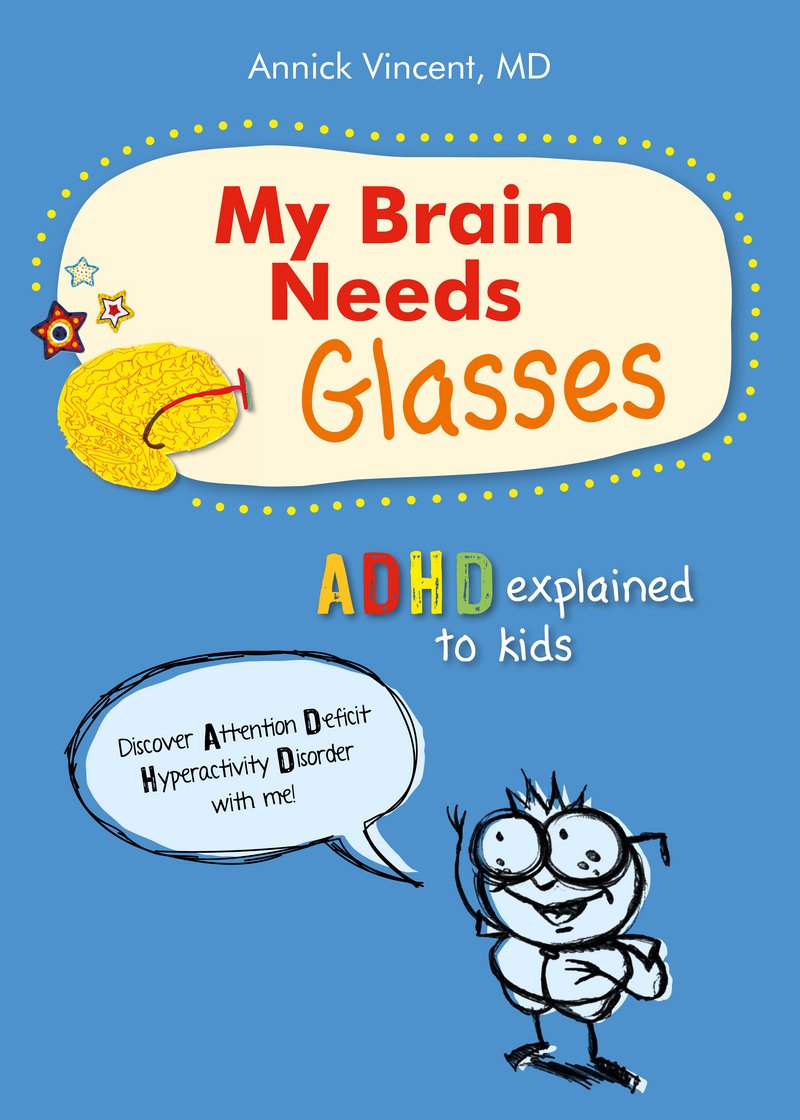

Today’s review is of My Brain Needs Glasses, a book that explains ADHD to kids. Unfortunately, this is another book that I would put in the reject pile.
Read on to find out why.
My Brain Needs Glasses: ADHD Explained to Kids
By Annick Vincent M.D. Illustrated by Mathieu Guerard
Children’s Non-Fiction
Summary:
My Brain Needs Glasses is narrated by a fictional 8-year-old boy named Tom. He tells readers about his struggles with ADHD, how he came to be diagnosed, and how he tries to help support his ADHD brain now.
The title of the book refers to one of the ways ADHD is explained in its pages. This explanation says that neurotransmitters in the brain are like traffic cops. Their job is to direct the traffic of a person’s thoughts and impulses, letting the most important ones go through, and slowing or stopping others. However, an ADHD brain’s “traffic cops” have poor eyesight, and they don’t do their job as well as they should. They frequently let too many thoughts through at once, and cause mental “traffic jams.” In this book, tools to accommodate ADHD (medication and coping strategies) are the “glasses” that the brain’s neurotransmitters use to help them do their job better.
The cover says that this book is for children, but I really couldn’t say what age or grade this book is appropriate for. Apparently, I’m not the only one. I can’t find a recommended age/grade on any online book retailers either. While it looks like a children’s book, with colourful subtitles and lots of pictures, the language choices are… interesting. It is filled to the brim with large vocabulary words such as “transmits,” “stimulates,” “consequences,” and “distinguishing;” and it uses expressions that only older generations would readily be familiar with. (For example: one of the tips in the book is to “Know Thyself.”)
Here’s a breakdown of the pros and cons/credits and cautions I see in this book.
Credits (The Good Stuff):
- The book’s layout is ADHD-friendly.
1. There are plenty of pictures breaking up the text, and important/main points are written slightly larger in a colourful font so they catch the eye.
2. The margins contain little doodles that relate to the text, which help distracted readers stay on-topic as much as possible.
3. The list of tips is broken up, put into little boxes, and spread out throughout the book, instead of being presented in one long/boring/intimidating list on a single page. - The book really nails some of its descriptions. In the opening pages, Tom describes what it feels like to have ADHD in a very relatable way. More than once, my son said, “I feel like that too!”
- I was happy to see that Hyperactive-Impulsive, Combined, and Inattentive ADHD were all talked about. Many books tend to focus on the HI characteristics, and miss Combined and Inattentive altogether. In this book, Tom has a Combined presentation of ADHD, and his mother has an Inattentive presentation of ADHD.
- The book includes a page of ADHD diagnostic criteria written in simplified language, which could be a very helpful tool for parents/adult readers who suspect ADHD.
- This book summarizes the ADHD experience, challenges, and potential areas of concern into a short, 53-page nutshell. While I don’t recommend this book for children (see below), some adult readers may find it helpful for getting up to speed quickly.
Cautions (Be Aware/The Bad Stuff):
- As I mentioned above, this book isn’t very child-friendly for a children’s book.
1. The vocabulary and figures of speech are more suitable to adult readers than children.
2. It’s really long for a children’s picture book: 53 pages. My son started reading it out loud to me, but got tired less than a quarter of the way through. I took over and only read a couple more pages before he got bored and asked to stop.
3. Don’t let the “child narrator” Tom, fool you. This book doesn’t have a very casual or conversational tone. It sounds very much like an academic lecture that has only been “dumbed down” slightly. - The glasses metaphor is hardly the only figure of speech in this book. The text is absolutely littered with similes, clichés, and turns of phrase. Considering that up to 50% of individuals with ADHD are also on the Autism Spectrum, I find it surprising that the writing isn’t more autism-friendly.
- Be aware that Tom experiences teasing in this book, and is called “stupid” and “lazy.”
- This book contains topics that don’t seem age-appropriate for 8-year-old Tom, or readers of the same age. (See “My Reaction” below)
- This book isn’t neuro-affirming.
While I can see that the author tried to say a few positive things about ADHD, the overall tone of the book has a negative view of ADHD. Tom’s ADHD is referred to as “a problem,” and the book talks about people who are “affected by ADHD,” as if they were suffering from a disease.

My Reaction:
I was disappointed when I learned that the title of the book and the content of the book barely match up. I was looking forward to the glasses metaphor as a creative way to describe ADHD in simple terms. Unfortunately this metaphor is not carried through the whole book; it is only mentioned on a few pages. Also, the illustrations don’t do the best job of making this metaphor visual. I was really hoping for a short and sweet book that stayed on theme and talked directly to children. What I got was a long lecture about ADHD that wasn’t very child-friendly at all.
I was also very surprised to find information in this children’s book that would be better suited for adults. Here are just two examples:
- This book touches on the difficulties ADHD-ers face in school, and mentions the high drop-out rate. Why would you tell an 8-year-old child that their odds of finishing school are diminished? Isn’t that risking it becoming a self-fulfilling prophecy? I believe children should be taught that they can succeed, and then supported on their journey to success; not told at the very outset that they are defective, and that the odds are not in their favour.
- This book dedicates one sentence to the subject of self-harm. This is a very real and serious issue that many people with ADHD face, and is certainly something that parents/caregivers/teachers should be looking out for. But why would you put the idea of self-harm into an 8-year-old child’s mind? And worse, why would you introduce the subject, but not take any time to talk about it properly? I read this sentence a few times in disbelief. This book seems to just casually tell 8-year-olds that they might try to hurt themselves someday, and that this is just part of what it means to have ADHD.
Towards the end of the book, our character Tom says that he feels uncomfortable talking about his ADHD, and doesn’t like it when people ask him questions about it. No kidding! This book spends most of its time pathologizing ADHD, and focusing on the negative aspects, then tries to tell Tom at the very end that he needs to stay positive and apply himself to overcome his problem. Barf!
Usually, I give books a pre-read before reading them with my kids. This time, my son saw this book in my library haul and asked to read it with me before I had had a chance to screen it. I am SO THANKFUL that we stopped reading it in the early pages before it got too bad, because this is definitely not a book I would choose for him.
Conclusion:
This book opens with six pages’ worth of prefaces and testimonials. It is clear that this book was helpful and touched a lot of people at the time it was written. I suspect it was one of the first books out there that tried to explain ADHD in a child-friendly way, and that had anything positive to say about ADHD at all. I am happy for the people that it helped, and I am glad that books like this one paved the way for the better books that we have now.
That said, this is not a book I can recommend, for two reasons:
- The negative way that ADHD is presented
The author is a doctor, so her perspective of ADHD (from a very clinical/medical lens) colours how she speaks about it. She is trained to see deviations from “normal” as a problem to be solved, which comes through loud and clear in this book. While she tries to mention a couple positives, her overall message sounds like this: ADHD is a terrible tragedy, and your life will be nothing but struggle, but there is a little hope!
I much prefer books that are written by people who are actually neurodivergent themselves, and don’t see their lives as a medical disaster. ADHD is not a disease. It is a genetic brain wiring difference that is decided before birth. We shouldn’t talk about it with the same doom-and-gloom language we use for life-threatening illnesses. - This book really seems to lose track of who its audience is.
If it’s actually a children’s book, it should speak accessibly and appropriately to children. If it is an information book for adults, then it should be that. A book could even have a children’s section and an adult section, clearly labeled. Unfortunately, this book does none of those things. It tries to talk to both audiences at once, making the book inappropriate for children, and unlikely to be picked up and read by an adult.
I think it’s fair to say that this book is a product of its time. It talks about ADHD in a primarily negative way, which is out of favour now. It also does a poor job of communicating to its advertised audience: children. My overall opinion is that this book belongs back in the time it was written. I’m sure it was seen as positive over a decade ago, but it very much misses the mark today.
©Ashley Lilley
This blog was written by a human being (me!) without the use of generative AI. I DO NOT CONSENT to having my work summarized by AI, or used for the purpose of training AI. Thank you for supporting human writers.
First time commenting? Please read my Comment Policy.
Discover more from Ashley Lilley
Subscribe to get the latest posts sent to your email.
 Ashley Lilley