
Time for another book review! This one’s all about ADHD.
NOTE: This post, and the book it’s about, come with a content warning: descriptions of abuse.
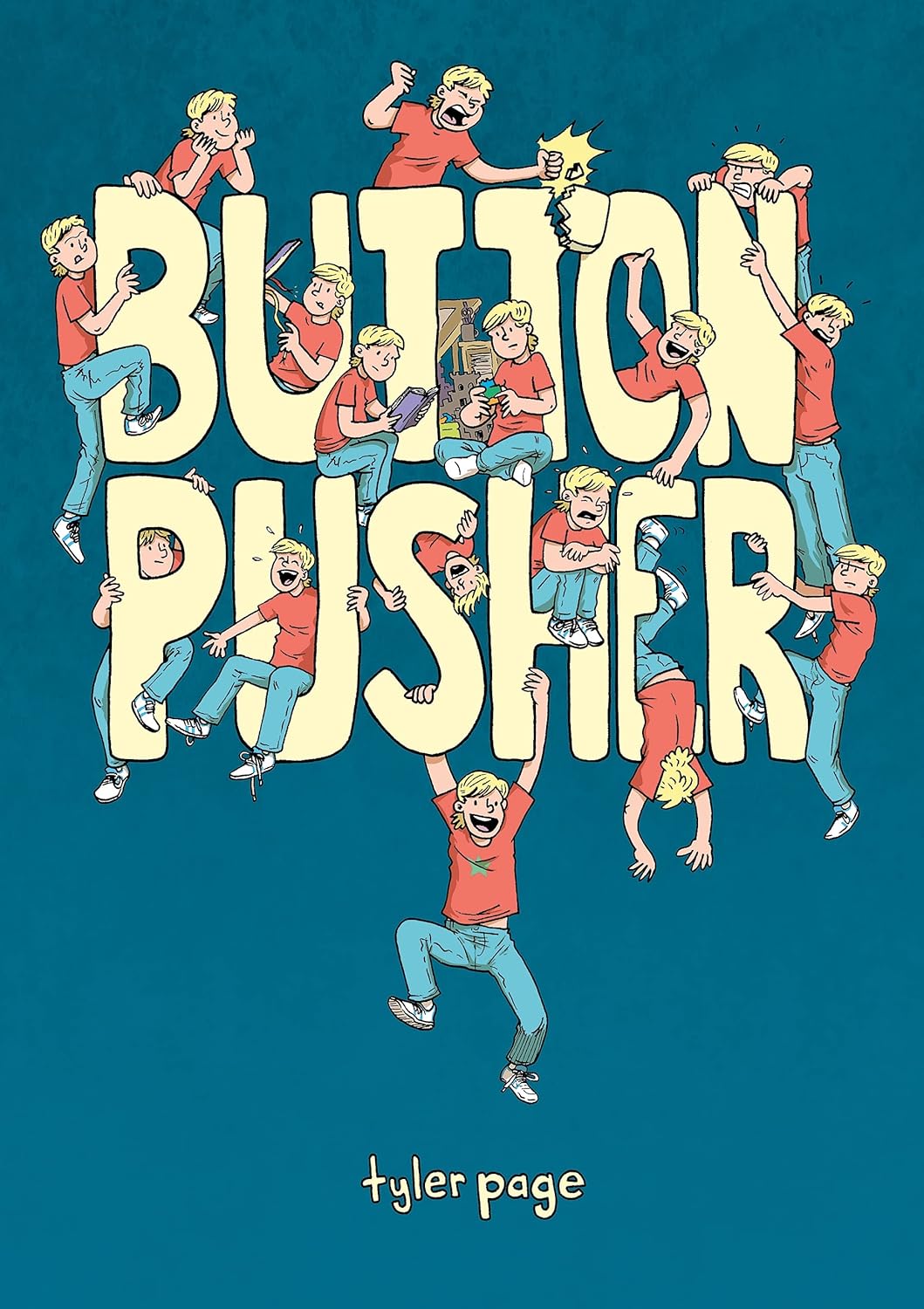
Button Pusher
by Tyler Page
Graphic Novel, Memoir
Button Pusher is Tyler Page’s memoir of growing up with ADHD in the 1980s and 90s. It is told in graphic novel, or “comic book” style, which makes it highly visual and easy to read.
Tyler is always getting into trouble at school for lack of attention, and poor impulse control. He frequently gets up and moves around in class, and does things “without thinking.” One of these impulse moments changes his life.
When Tyler is given his grandfather’s jack knife as a gift, he brings it in his backpack to school. While on the bus, Tyler succumbs to the impulse to see what the knife feels like on leather, and cuts up his seat. This incident sends off alarm bells. The Principal, and later, Tyler’s doctor, become worried that his “violent behaviour,” (readers know that it is actually impulsive behaviour) is due to issues at home. This leads to family counselling, group counselling, and eventually an ADHD diagnosis and a Ritalin prescription.
While Tyler’s ADHD becomes the scape goat for his family’s unhappy home life, the problem is far bigger than him. His father is also depicted as struggling with undiagnosed ADHD, and he is just as impulsive as Tyler. He goes through years of trying various antidepressants to control his moods and energy levels, which ultimately do not help.
His father is also abusive. While Tyler depicts most of the violence “off screen,” there are images of him getting spanked. There are also images of smashed walls, bruises on his mother, and the children hiding while screaming and banging can be heard from the next room. Later in the book, when Tyler is a teen, he gets into a physical altercation with his father while defending his mother.
Tyler’s mother was raised religious, and is encouraged to stay in her marriage no matter how bad it gets. While her family eventually reverses their stance, it is too little too late. Years have passed, and his mother is too frightened and traumatized to leave.
Despite his tumultuous home life, Tyler begins to thrive on his new medication. He makes and keeps friends easier, gets into less trouble, earns better grades, and uses his improved focus to pursue his passion for art and hone his drawing skills.
Unfortunately, Tyler’s parents and medical providers make a serious (and sadly, all too common) mistake: they never tell him about his ADHD diagnosis. He knows he’s taking Ritalin, but no one explains why. In the nineties, ADHD and Ritalin become a hot-button topic, creating a lot of media sensationalism and panic. Tyler pieces together that he has ADHD from a news segment, and quickly internalizes a lot of shame and stigma. He begins to blame his medication for his problems and eventually takes himself off of it without medical supervision.
The book concludes with Tyler preparing to leave for college, believing that the ADHD chapter of his life is closed. But, with his final sentence, he foreshadows that his ADHD story is actually far from over.
I would think about ADHD again someday.
-Tyler Page, Button Pusher
My greatest life challenges related to ADHD were actually ahead of me. Relationships, work, marriage, parenting.
But that’s another story.


Credits (The good stuff):
- It’s a graphic novel.
You’ve heard me praise graphic novels before, with good reason. This style of writing is particularly great for neurodivergent readers. The illustrations keep readers engaged for longer, and provide context clues and clarity to the text.
For a book written by an ADHD-er, about ADHD, for ADHD-ers, the author couldn’t have selected a better format. - This book is a remarkably good depiction of life with ADHD. It connects information with lived experience, and sheds light on the emotional and mental weight of navigating ADHD challenges. It shows how confusing ADHD can be for someone who doesn’t know they have it, and who can’t explain the “why” behind their actions. It gives readers a real picture of what ADHD “looks like,” instead of reducing it to lifeless descriptions and checklists.
- This book leaves plenty of bread crumbs. What do I mean by that? Well, by simply telling his story, the author mentions several tiny details about the ADHD experience. Many of these aren’t expounded on, but they are present, giving readers a chance to think, “Huh, that happens to me too.” For example, Tyler shows himself getting frequent ear infections. This is a common neurodivergent experience. And while he never connects this information to his ADHD, it is there for others to find and relate to.
- Throughout the book, the author has included several infographic pages (in a different colour scheme so they are easy to identify) about ADHD topics. He educates on the history of ADHD, executive function, how medications work, and more.
Cautions (Be aware):
- Don’t let the abundance of illustrations fool you: this book is not for young children.
The Amazon recommended age is 10-14 years old, but I would be hesitant to recommend it to anyone that young. Certainly not without a content warning, at least.
This book contains censored and uncensored swearing, an inappropriate joke, depictions of corporal punishment, and several portrayals of verbal and physical abuse. The theme of domestic abuse throughout the book is just as strong, if not stronger, than the theme of ADHD.
The irony is not lost on me, that I am here saying, “this is too heavy for some children to read about,” while the author had no choice but to live through it all as a young child. My heart breaks for him, every survivor, and everyone living in a volatile home. - In addition to the heavy themes, this book may also introduce some unwanted stigma around ADHD in young readers.
We are thankfully moving into an era where ADHD is far more understood, accepted, and even celebrated. (Simone Biles, anyone?) So there is potential that a tween who is used to a more positive approach may pick up some insecurities and stigma from this story.
This is just a “be aware.” I recommend that caregivers pre-read this book to see if it is right for the child in their care. It may be unhelpful, or it may be exactly what they need to hear, depending on their life circumstances.
Really, I could combine and distill all of my concerns about this book into one simple phrase: “Parental Guidance Recommended.” - Just a small thing:
One of the infographics talks about the idea of neurodiversity, by saying that people belong on a spectrum, instead of into little boxes. The accompanying picture shows a linear line with the words Autism, ADHD, and Dyslexia on it. While this does help illustrate the author’s point about neurodiversity, this picture could also confuse readers.
Since “The Spectrum” is such a widely used term for Autism, it’s possible someone could confuse the author’s depiction of “a spectrum of human intelligence and behaviour” for the Autism Spectrum. They could easily (falsely) conclude that ADHD and Dyslexia are a part of, or synonymous with, Autism.
This is a small blip that doesn’t change the overall message and quality of this book, but my accuracy-driven, facts-loving, neurodivergent brain simply can’t let it go without a mention!
Conclusion:
Stories are powerful. By telling his own, Tyler Page makes the ADHD experience relatable. His format also makes it accessible to so many more people: people who would be too intimidated to pick up a thick, nonfiction book.
This book touched me. Although I have a different type of ADHD than the one shown, there were still so many moments that I could relate to. The author does a good job of showing the emotional mind games that happen when you know that you are different, but cannot explain how or why. I related to his struggles, his fears, and his anger. I believe this book could help late-diagnosed adults in their twenties, thirties, and beyond, really understand their childhoods for the first time. I hope the author writes a sequel about how ADHD shows up in his adulthood, as I believe it could potentially help so many people see themselves and seek diagnosis.
For the late-diagnosed adult, this book is worth checking out. It could help bring clarity, and give you the language you need to make sense of your growing-up years.
For adults in general, perhaps with grown children who are getting diagnosed late, this book may give you a glimpse into their experience, and help you understand ADHD in a new way.
For tweens, and teens, please see my cautions above, and use discretion.
©Ashley Lilley – First time commenting? Please read my Comment Policy.
Disclosure: No affiliations here! While this page may contain links to products, I am not an affiliate or ambassador for any brand. I do not receive commission or kickback of any kind for recommending products. Just sharing stuff I love, and hope it helps someone. If you wish to support my blog in some way, please consider following me on social media and sharing my links with your friends. -Ashley
Discover more from Ashley Lilley
Subscribe to get the latest posts sent to your email.
 Ashley Lilley