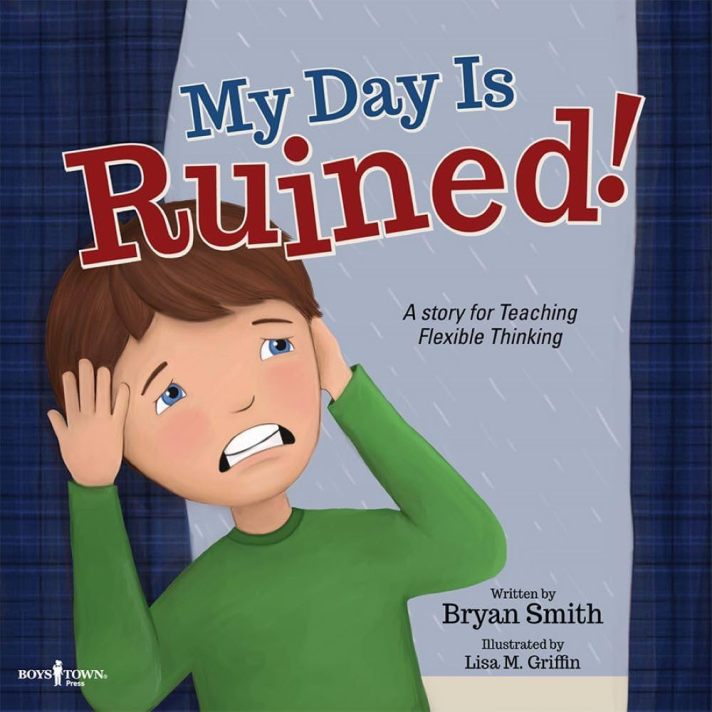
Today I have another children’s book review: My Day is Ruined! A Story Teaching Flexible Thinking.
This book was put on my radar by a fellow blogger over at How Autism Self-Advocacy Revolutionized My Life. Kim is an autism blogger who writes from the perspective of an autistic adult. You’ll often find me and her in each other’s comment sections. Go give her blog a follow–particularly if you enjoy my book review posts–because if I haven’t reviewed a book yet, there’s a good chance she has! 🙂
First: What is Flexible Thinking?
Flexible thinking is part of a group of skills commonly known as “executive function.” If you want more information on executive function, you can check out my blog series from earlier this year:
Flexible thinking, is a common name for a small part of a larger executive function skill called “cognitive flexibility.”
Cognitive flexibility refers to the mind’s ability to adapt to new information, process and apply new information, or to shift between different sets of information/different goals/different points of view. Some skills that rely on cognitive flexibility are: multitasking, transitioning from one activity to the next, reflecting, empathy, problem-solving, and creativity.
Flexible thinking refers specifically to the skill of being able to adapt and change one’s mind/opinions/plans/goals/etc… in light of new information or new circumstances.
My Big Concern Before Reading this Book:
People with neurotypically-wired brains have a big advantage when it comes to executive function skills. Neurodiversely-wired brains (including–but not limited to–brains that are autistic and ADHD) are at a disadvantage in this area.
Neurodiverse individuals struggle greatly with executive function skills, simply due to their brain’s unique wiring. A major diagnostic criteria for getting an autism or ADHD diagnosis is a strong disability in the area of executive function. Some brains simply do not work the exact same way that others do. This is nothing to be ashamed of, and it is NOT–in any way–a moral failing or attitude defect. Unfortunately, not everybody knows that. And unfortunately, most individuals with executive function challenges are insulted, ostracized, and bullied by their neurotypical peers and authority figures.
With that in mind, here is the book description I read on Amazon:
“Braden [is] on an overreaction tailspin! Will Braden be able to recover from his overreacting tendencies and practice the tips of flexible thinking that his teacher and mom teach him? Find out in…”
No lie, the description turned me off. I immediately worried that this would be another ablest book that tries to push “normal” behavior onto certain kids who quite literally have a disability hindering them from acting the way people want them to. Oh great, I thought, let’s just label children who are genuinely struggling as “overreacting,” so we can shame them into behaving better while ignoring their underlying challenges.
Unfortunately, I wasn’t too far off.

My Day is Ruined! A Story for Teaching Flexible Thinking
By Bryan Smith, Illustrated by Lisa M. Griffin
Children’s Fiction, Educational/Life Skills, Middle Grade
Braden keeps running into upsets that completely ruin his day:
- A fire drill interrupts his quiet reading time before he can finish his book.
- It rains on the day of his big baseball game.
- He is asked to show his work in math class, and he doesn’t understand how to do that.
- The school cafeteria runs out corn dogs on corn dog day, and he doesn’t get one.
Both Braden’s teacher and mother have a talk with him about flexible thinking. Here are the four steps they teach him:
- Take a deep breath.
- Realize some things are out of your control.
- Change your plan.
- Accept the change.
Credits: (The Good Stuff)
- I think Braden’s struggles are realistic and will be relatable to readers his age. This is a good reminder for adult readers: just because something seems like “no big deal” to an adult, doesn’t mean that it can’t be a very big deal to a child.
- There are two versions of Braden in this book. One is “Story Braden,” who shows us his vulnerability though the story. Story Braden lets us see the insecurities and big feelings behind his struggles.
The other is “Narrator Braden.” When Braden narrates his story he comes across as short-tempered and stubborn with a “bad attitude.”
Both versions of Braden are really important for adult readers to see. Sometimes the kid who comes across as “stubborn,” is actually afraid and struggling to deviate from a familiar comfortable routine. Sometimes the kid with “an attitude,” is hiding their confusion and panic behind snippy words instead of tears. - The book itself is designed to be easy to read. Text is broken up into small chunks, placed in boxes, put into different colours, and made bigger or smaller for emphasis. It’s visually appealing and easy to follow, particularly for someone who is ADHD.
Cautions: (Be Aware/The Bad Stuff)
- When the fire drill interrupts Braden’s reading time, he gets very upset. The book uses this as an example of how he can’t go with the flow. There is no mention of how the sudden sensory assault could be causing him physical pain, or that the unplanned interruption of his routine could be very scary for him.
This book is directed at children who struggle with executive function, (and therefore, are very likely autistic or ADHD), yet there doesn’t seem to be any understanding of how neurodivergent minds work in the book. Which is unsettling. It makes me feel like my gut reaction was correct: someone trying to teach kids “how to be normal,” or “how to behave.” - I don’t like how the teacher didn’t explain the math problem to Braden in the first half of the book. She was far more concerned about Braden’s reaction to the question than helping him understand the question, which makes her talk about flexible thinking a discipline measure, not a genuine attempt to help a struggling child. Which is disappointing.
- I may have groaned out loud when the first step taught to Braden was, “take a deep breath.” I am very over this trend of telling people to “take a deep breath.” Never in the history of calming down have the words “take a deep breath” successfully calmed someone down. In fact, it’s more likely to cause trouble by upsetting the person further (by adding a patronizing platitude on top of everything else they are experiencing), or by causing them to hyperventilate, since they were, in fact, breathing before you commanded them to breathe more.
Could we all, as a collective, try to just say what we really mean when we use the phrase “take a deep breath”? How about, “Feel your feelings first. I’ll wait for you.” Or, “When you feel able to talk to this through, I’ll be here.”? Both are loads more helpful, and less ambiguous. - While parts of this book could be helpful for neurotypical children who are building their executive function skills, it is important to remember that not all children are wired the same. A neurodiverse child, with a disability that hampers their ability to learn executive function skills, may not be ready for this book at the age it is targeted for.
In order for a book like this to be effective, it must be shared with a developmentally appropriate audience. It may simply not be suitable for your middle-grade autistic or ADHD child/student any more than it is for a three-year-old. Unfortunately, it is all too likely that these children are exactly the kids who are going to have this book given to them. Because someone in their life wants to fix their behaviour instead of understand their behaviour.
Truly, my biggest concern with this book (and so many like it) is that it will be used bully a child that it is not appropriate for; making them feel guilty and defective for not catching onto advanced brain functions as quickly other people do. I will not say that this was the author’s intention when he wrote it (since I do not know him), but whether he intended it or not, there is a chance that this book could hurt more than it will help.
Conclusion:
To sum up, I really don’t think I can recommend this book. While I am hoping and willing to believe that the author had good intentions, I fear that this book could be used to do more harm than good. The overall tone made me feel like this book was about fixing problem kids so they are easier to handle, and not about teaching a child something in a way that they will understand and benefit from.
©Ashley Lilley – First time commenting? Please read my Comment Policy.
Discover more from Ashley Lilley
Subscribe to get the latest posts sent to your email.
 Ashley Lilley
You do such great work Ashley!
LikeLike
There is one comment in here that may be true for some, but I personally disagree with it. People telling me to take a deep breath actually helps. It helps me take a step back from the situation and be able to respond instead of react.
This is not meant to be an unfriendly post. I am just meaning to give another perspective on that one point.
LikeLiked by 1 person
I’m glad to hear that it’s helpful for you. Thanks for commenting 🙂
LikeLike