


Today is all about Ninjas! This series of picture books by Mary Nhin features an ever-growing cast of emotionally intelligent Ninjas who help guide kids through their emotions and help them develop healthy attitudes and coping skills.
These books are written at about a Grade 2-Grade 4 reading level, but the simple stories can easily be read aloud to kids as young as three or four years old.
Here are four titles I picked to take a closer look at:
Anxious Ninja
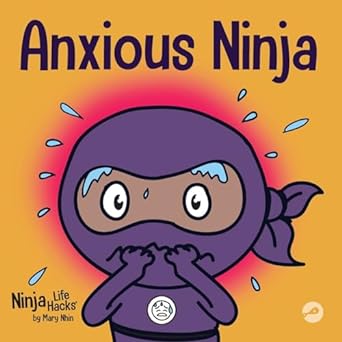
Anxious Ninja always does amazing at track and field practice, but when it comes to competitions, his anxiety always gets the better of him. His friend, Gritty Ninja teaches him 3 R’s to help conquer his worries.
R – Recognize: Recognize when you are focusing on situations you can’t control.
R – Relax: Relax your body by taking a few deep breaths.
R – Refocus: Repeat positive mantras to yourself to keep your mind on track.
During Anxious Ninja’s next race, his mind began to drift. What if he lost? Would he disappoint his parents? Thankfully, he remembered the Three R’s. He recognized he was worrying about things outside of his control, and that all he could control was how well he was running right now. Next, he calmed himself with a few deep breaths. Finally, he repeated to himself with every step, “Work hard, work hard, work hard.” He pulled into the lead and won the race.
Overall, this is a positive little story about not letting worries get the better of you. However, the ending was a bit of a letdown for me, personally. I kind of wish Anxious Ninja didn’t come in first place. I think I would prefer it if he came in third place instead. Then, he could have the experience of the world not ending when things don’t go as planned, reinforcing the idea that our worries are rarely as terrible and they make us believe. But that is my preference, and perhaps too much to ask of a children’s book aimed at this age.
I would also like to note that this book is about everyday anxieties, and does not address anxiety disorders or panic attacks.
Focused Ninja

Focused Ninja can finish his homework through all the noise of his mom cooking and his siblings doing music practice. He accomplishes this by using the “F.O.C.U.S.” method.
F – Find distractions and eliminate them.
O – Organize.
C – Choose greens and healthy foods.
U – Use exercise to give your brain a boost.
S – Split up large assignment into smaller tasks
He then goes on to tell us how he applies the F.O.C.U.S. method at school: He found and eliminated distractions by choosing a seat at the front of the class. He organized his desk. He ate a salad at lunch. He ran during recess for exercise. Then, he split up his assignment into smaller tasks and created a checklist.
This book left me more puzzled than inspired, if I’m being honest. If Focused Ninja is supposedly applying the F.O.C.U.S. method, why was he doing homework while his brother and sister played the drum and trumpet at the beginning of the book? Shouldn’t he have eliminated that distraction by going to a quiet place? Also, how is a child realistically supposed to apply this method? In all the schools I am familiar with, teachers assign desks to students; students don’t choose them. In many families meal decisions are made by the parents, and meals are directly affected by cultural and financial considerations. Does a child really have to power to decide that they will only eat salads at lunchtime?
While the F.O.C.U.S. method is certainly a good idea that contains some good strategies, I’m not sure it could be effective without parents and educators onboard. This is the kind of book that families and classrooms need to read and work on together, not just one individual child.
Grumpy Ninja
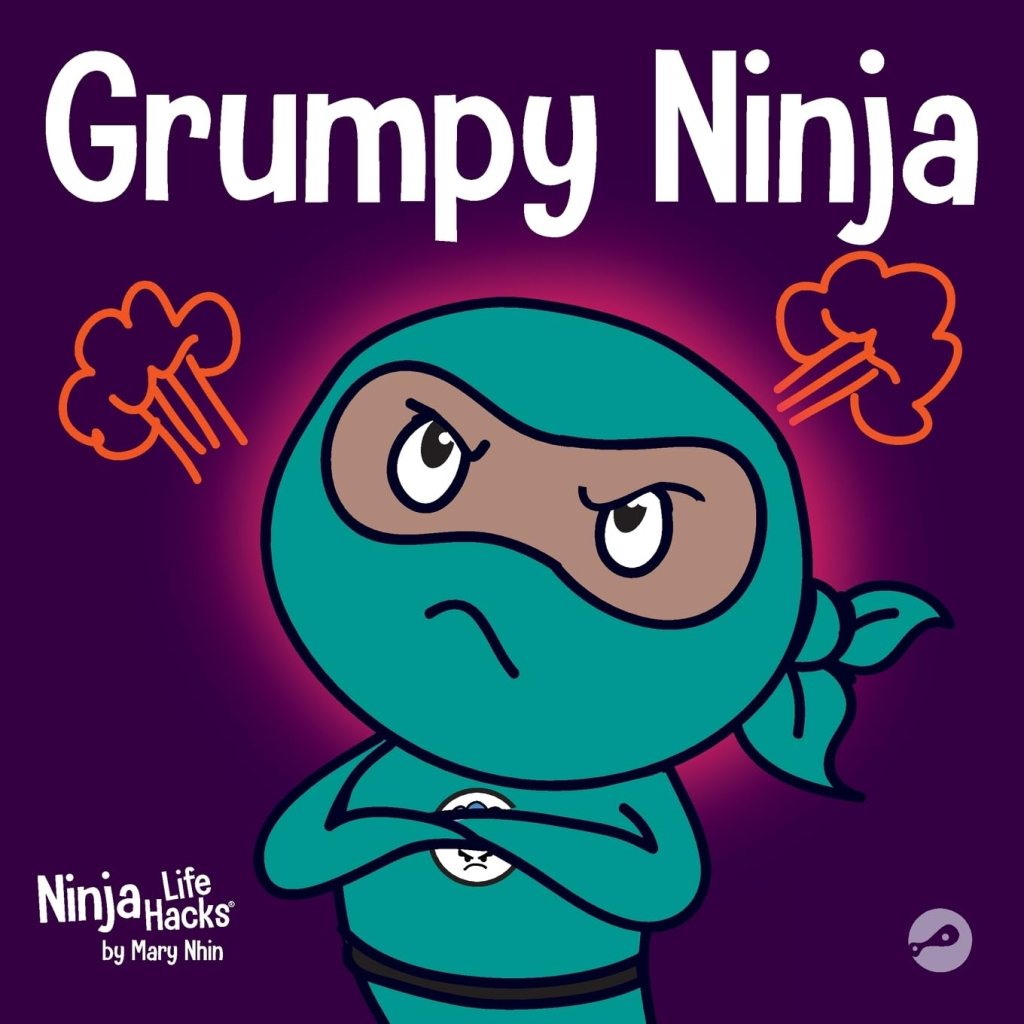
Grumpy Ninja’s day didn’t get off on the right foot. First, breakfast was his sister’s favourite breakfast food, not his. Then he was late for school. And then his pencil sharpener didn’t work properly. Grrrr! After school, he went to the beach with his friends and his mood improved. He wondered how he could feel that good all the time! His friends, Earth Ninja and Positive Ninja fill him in on two secrets to banishing grumpiness: relaxation & gratitude.
Grumpy Ninja’s friends encourage him to do more activities that lift his mood, such as reading, or creating art, or playing outside. They also encourage him to notice and appreciate the good things he experiences each day, like the warm sunshine, how good the air smells, or how much his family loves him.
Grumpy Ninja’s mood improves each day that he prioritizes relaxation and gratitude. And so will yours! This is a good reminder for kids and adults alike.
Confident Ninja
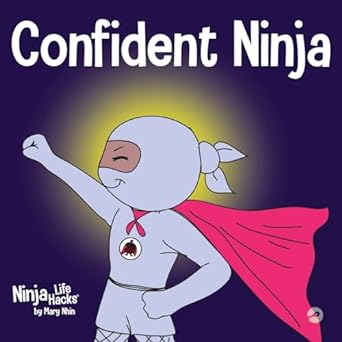
Confident Ninja shares how he overcame low self esteem by using The Confidence Code.
The Confidence Code:
– Picture yourself succeeding.
– Practice failing.
– Put your goals down on paper.
The first step to confidence is to picture yourself succeeding by banishing negative thoughts. When negative thoughts such as, “I can’t do it” show up, you need to replace them with better thoughts. Confident Ninja recommends writing down good things about yourself and repeating them often. He sticks positive affirmation on his mirror to look at each day. Some examples are: “I am brave,” “I am kind,” “I can do anything.”
The second step to confidence is to practice failing. Failure isn’t a bad thing! Failure is just a part of learning. You won’t do things perfectly the first time you try them, but if you are determined to keep trying, you’ll see yourself improve.
The third step is to put your goals down on paper. Confident Ninja writes his down as a “Goal Rocket.” He writes his big goal at the top, and smaller goals (the steps he needs to take to achieve his big goal) underneath it. Then, he works through the steps, one by one.
Confident Ninja’s big goal is to make the basketball team. He begins by banishing discouraging thoughts, and telling himself that he can. He practices his basketball skills. And, he puts together a goal rocket to encourage himself to take smaller steps each day, like eating well, getting exercise, and practicing. Confident Ninja doesn’t make the basketball team the first time he tries out, but he is determined to try again. He remembers that failure is part of the process. He continues to work the steps of the Confidence Code until he makes the team.
Practicing the Confidence Code doesn’t just help Confident Ninja make the basketball team. It also allows him to do other things confidently, such as asking for help when he is confused in school (because he is no longer afraid of looking bad), and trying something new even if he might look silly the first time (because he knows that failure is a part of learning), and speaking up for others who are being bullied, (because he remembers one of his positive affirmations, “I am kind.”)
This was my favourite Ninja book. I really like the positive message, and I feel like this one is written the best of all the titles I check out.
Overall, I like the idea behind this book series. It’s a fun and upbeat way to teach children so many important life lessons. In my opinion, some of the books are “a swing and a miss,” but I do think they are worth checking out through your local library, and finding the titles that are the right fit for your family or classroom.
©Ashley Lilley – First time commenting? Please read my Comment Policy.
Discover more from Ashley Lilley
Subscribe to get the latest posts sent to your email.
 Ashley Lilley